
Commercial Lighting Market Set for Significant Growth as Revenue Reaches USD 93.15 Billion by 2035
Commercial Lighting Market Size, Share & Research Report By Application (Indoor Lighting, Outdoor Lighting, Accent
Press Release Disclaimer: This is a press release distributed through the XPR Media network. It has not been independently verified by our newsroom.

Commercial Lighting Market Size, Share & Research Report By Application (Indoor Lighting, Outdoor Lighting, Accent Lighting, Emergency Lighting, Smart Lighting)
NEW YORK,, NY, UNITED STATES, September 7, 2026 /EINPresswire.com/ — ➤ Market Overview
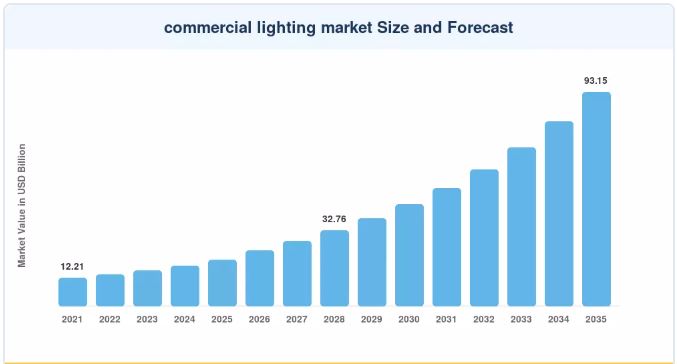
The Commercial Lighting Market reached an estimated USD 20.15 billion in 2025 and enters the forecast window at USD 24.30 billion in 2026, climbing to USD 93.15 billion by 2035 at a 16.1% CAGR. This expansion reflects accelerating replacement of legacy fluorescent and high-intensity discharge fixtures, rapid adoption of connected LED luminaires, and rising investment in energy-efficient, wellness-oriented commercial buildings.
Asia-Pacific commanded approximately 78% of the Commercial Lighting Market in 2025, supported by large-scale manufacturing, aggressive building-code modernization, and smart-city construction across the region. Building owners and specifiers are increasingly moving toward integrated luminaire-plus-control assemblies that bundle sensors, wireless connectivity, and analytics into a single fixture, reducing the operational burden of managing lighting, energy consumption, and compliance separately.
Africa is advancing at a projected 21.5% CAGR through the forecast period, making it the fastest-growing region for commercial lighting. Rapid urbanization, expanding commercial floor space, and multilateral electrification programs are creating substantial opportunities for luminaire manufacturers and lighting-as-a-service providers entering the region.
Europe held roughly 9% of the Commercial Lighting Market in 2025, supported by regulatory phase-outs of fluorescent lighting and the EU’s Renovation Wave Strategy. Governments and building operators across the region are prioritizing energy performance, data-driven building management, and lifecycle carbon reduction, creating steady demand for networked, high-efficacy luminaires.
Download Sample Pages of Research Overview –
https://www.marketresearchfuture.com/sample_request/21748
➤Commercial Lighting Industry Landscape
Commercial lighting encompasses luminaires, lamps, drivers, sensors, and control systems installed across offices, retail stores, hospitality venues, healthcare facilities, and industrial spaces. Rather than relying solely on standalone fixtures, building operators increasingly work with manufacturers and integrators that combine hardware, wireless controls, and cloud-based analytics into a single managed lighting platform.
The shift from legacy magnetic-ballast fluorescent and metal-halide fixtures toward solid-state LED platforms is reshaping the competitive landscape. Regulatory phase-outs, declining LED cost-per-lumen, and building codes mandating occupancy sensing and daylight-responsive dimming are compressing replacement cycles and pushing specifiers toward connected, data-capable luminaires.
The LED Lighting Market is a relevant topical authority keyword because commercial lighting demand is increasingly concentrated in LED-based products. LED sources are forecast to grow faster than conventional lighting technologies as chipset costs decline and color-rendering performance approaches incandescent-class benchmarks, reinforcing LED as the dominant light source across new construction and retrofit projects alike.
The connection between the broader LED lighting market and commercial lighting demonstrates how solid-state technology has become foundational to modern building infrastructure. As organizations pursue energy efficiency mandates and sustainability targets, they require light sources that combine long operational lifespans, low power consumption, and compatibility with networked control systems, creating durable demand across both markets.
➤ Key Growth Drivers
Regulatory phase-outs of fluorescent and high-intensity discharge lamps remain a major growth driver for the Commercial Lighting Market. Policies restricting the sale of legacy lamp technologies across dozens of countries are compressing natural replacement cycles, pushing building owners toward LED-based alternatives sooner than they otherwise would have upgraded.
Declining LED costs are another significant factor supporting industry expansion. As package prices continue to fall and payback periods shorten, small and mid-size commercial tenants that previously found connected lighting cost-prohibitive are increasingly able to justify the investment, broadening the addressable market beyond large enterprise customers.
➤ Smart Building Integration
Building codes and standards mandating occupancy sensors, daylight-responsive dimming, and networked scheduling are creating substantial opportunities because commercial properties must now specify connected control hardware alongside every new luminaire. This compliance-driven demand is lifting average selling prices and accelerating adoption of connected lighting across new North American and European construction.
Facility managers are also seeking unified platforms that combine lighting, HVAC, and security systems into a single building-management interface. Cloud managed services can simplify these operations through centralized dashboards, automated scheduling, and cross-system analytics that reduce the operational burden of managing multiple building subsystems independently.
➤ Lighting-as-a-Service and Financing Models
Lighting-as-a-Service arrangements are transforming how building owners fund upgrades by bundling hardware, installation, maintenance, and analytics into a predictable monthly operating expense. This model removes the first-cost barrier that has historically discouraged smaller commercial tenants from adopting connected lighting, and is expected to expand meaningfully through the forecast period.
Sustainability-linked financing is also playing a growing role. Green-bond structures that tie interest rates to verified energy reductions are unlocking capital for large-scale retrofit projects, as lighting upgrades remain among the most easily measured and documented building interventions available to owners pursuing ESG-linked lending.
Buy Now Get Comprehensive Market Insights –
https://www.marketresearchfuture.com/checkout?currency=one_user-USD&report_id=21748
➤ Wellness and Compliance-Driven Demand
Occupant wellness and regulatory compliance are increasingly central to enterprise lighting strategies. Organizations operating Class-A office space, healthcare facilities, and hospitality venues are adopting tunable-white and circadian-responsive luminaires that support occupant health, talent retention, and certification requirements under standards such as WELL and Fitwel.
Cybersecurity and data governance are becoming more important as luminaires increasingly connect to building networks. Manufacturers are adopting encrypted device communication, certificate-based provisioning, and firmware-signing practices to protect networked lighting infrastructure from unauthorized access as adoption of connected systems grows.
➤ Market Segmentation
The Commercial Lighting Market can be segmented across lighting type, light source, end use, installation type, and connectivity. Luminaires account for the majority of market revenue as specifiers increasingly favor pre-integrated fixtures over standalone lamps, while LED remains the fastest-growing light source given regulatory mandates and superior efficacy.
Commercial offices represent the largest end-use segment, driven by tenant-wellness mandates and lease-cycle renovation triggers, while healthcare is the fastest-growing vertical due to clinical evidence linking circadian lighting to improved patient outcomes. Retrofit and renovation projects continue to outpace new construction as the aging global commercial building stock favors low-disruption lighting upgrades over full redevelopment.
➤ Enterprise Adoption Trends
Large enterprises and commercial real estate operators remain important customers because they manage extensive floor space and complex portfolios requiring centralized monitoring, energy reporting, and compliance across multiple jurisdictions. Managed lighting programs allow these organizations to supplement internal facilities teams with specialized expertise and continuous operational support.
Small and medium-sized commercial tenants are becoming an increasingly important customer segment as Lighting-as-a-Service models and utility rebate programs lower first-cost barriers. These businesses can access connected LED technology without extensive capital investment, allowing them to benefit from the same energy savings and analytics capabilities available to larger enterprises.
➤ Regional Insights
Asia-Pacific held approximately 78% of the Commercial Lighting Market in 2025, reflecting the region’s manufacturing scale, aggressive new-construction volume, and large-scale smart-city programs. China alone manufactures the majority of global LED packages, while India’s government-backed procurement programs are expanding into commercial and street-lighting tenders.
Africa is projected to advance at a 21.5% CAGR throughout the forecast period, the fastest of any region, supported by urbanization rates exceeding 4% annually and multilateral electrification initiatives. Growing commercial floor space and greenfield construction are allowing the region to adopt LED and connected lighting from inception rather than through retrofit.
Europe is developing steadily, supported by regulatory fluorescent phase-outs and the EU’s Renovation Wave Strategy targeting energy upgrades across millions of buildings. North America continues to benefit from mature utility rebate infrastructure and expanding tax incentives for energy-efficient commercial buildings, sustaining demand for high-efficacy and connected luminaires.
➤ Emerging Opportunities
One of the most significant opportunities involves data monetization through connected lighting infrastructure. LED luminaires equipped with indoor positioning and occupancy-sensing capabilities allow retailers and warehouse operators to generate foot-traffic analytics and asset-tracking data, turning the ceiling grid into a revenue-generating infrastructure asset.
Another opportunity is the development of industry-specific lighting solutions for healthcare, hospitality, and retail environments. Providers that combine energy-efficient hardware with sector-specific expertise in infection control, guest experience, or visual merchandising can offer more targeted solutions and build stronger long-term relationships with commercial building owners.
➤ Key Challenges
Despite strong growth potential, the industry faces several challenges. High upfront costs for connected systems can elevate installation costs well above standard LED retrofits, keeping price-sensitive segments such as small retail and multi-tenant common spaces from adopting advanced platforms.
Interoperability fragmentation across competing control protocols remains an ongoing concern, as building owners worry about vendor lock-in and stranded wireless infrastructure. Skilled-labor shortages for complex connected-lighting installations, along with cybersecurity risks in networked luminaires, add further complexity that manufacturers and integrators must address to sustain adoption.
➤ Future Outlook
The Commercial Lighting Market is expected to maintain strong expansion as enterprises increasingly prioritize energy efficiency, occupant wellness, and building-management integration. Growth from USD 20.15 billion in 2025 to USD 93.15 billion by 2035 represents a substantial increase in demand for LED luminaires, connected controls, and lighting-management platforms.
Future development will increasingly center on AI-driven autonomous lighting, software-defined platform economics, and ESG-linked energy reporting requirements. Providers that combine technical expertise with cybersecurity, compliance capabilities, and flexible service models such as Lighting-as-a-Service will be well positioned to capture long-term opportunities.
Browse Full Report Details –
https://www.marketresearchfuture.com/reports/commercial-lighting-market-21748
➤ Key Takeaways
The Commercial Lighting Market is being shaped by regulatory phase-outs of legacy lamp technologies, declining LED costs, smart-building integration mandates, and rising occupant-wellness expectations. Asia-Pacific remains the leading regional contributor, while Africa demonstrates the strongest growth potential and Europe benefits from renovation-driven regulatory momentum.
The integration of connected controls, analytics, and flexible financing models such as Lighting-as-a-Service will increasingly redefine how commercial buildings procure and manage lighting. At the same time, related technology areas such as the LED Lighting Market demonstrate the growing requirement for efficient, connected, and intelligent lighting infrastructure. As businesses prioritize sustainability and operational efficiency, commercial lighting is expected to become an increasingly strategic component of enterprise real estate strategy.
➤ Frequently Asked Questions
Q – What role does UV-C integration play in the Commercial Lighting Market post-pandemic?
A – Upper-air UV-C fixtures integrated into recessed ceiling luminaires are gaining traction in healthcare and education. Adoption remains niche at roughly 3–5% of new projects, limited by safety-certification timelines and higher fixture costs.
Q – How do circadian lighting specifications influence fixture premiums in the Commercial Lighting Market?
A – WELL v2 circadian-compliance fixtures carry a 20–30% price premium over static-white equivalents. Tenants in Class-A office markets absorb this premium as a talent-retention investment tied to occupant satisfaction scores
➤➤➤ Industry Analysis Reports by Market Research Future:
Italy Fuel Card Market-
https://www.marketresearchfuture.com/reports/italy-fuel-card-market-46102
India Fire Protection Systems Market-
https://www.marketresearchfuture.com/reports/india-fire-protection-systems-market-46791
Ip Telephony Market-
https://www.marketresearchfuture.com/reports/ip-telephony-market-5695
Haptic Technology Market-
https://www.marketresearchfuture.com/reports/haptic-technology-market-4011
Wealth Management Software Market-
https://www.marketresearchfuture.com/reports/wealth-management-software-market-23061
Corporate Lending Market-
https://www.marketresearchfuture.com/reports/corporate-lending-market-24324
Brazil Fire Protection Systems Market-
https://www.marketresearchfuture.com/reports/brazil-fire-protection-systems-market-46793
Us Pressure Transmitters Market-
https://www.marketresearchfuture.com/reports/us-pressure-transmitters-market-18125
Oxygen Gas Sensor Market-
https://www.marketresearchfuture.com/reports/oxygen-gas-sensor-market-36393
Integrated Circuit Chip Market-
https://www.marketresearchfuture.com/reports/integrated-circuit-chip-market-13910
Market Research Future
Market Research Future
+1 855-661-4441
email us here
Legal Disclaimer:
EIN Presswire provides this news content “as is” without warranty of any kind. We do not accept any responsibility or liability
for the accuracy, content, images, videos, licenses, completeness, legality, or reliability of the information contained in this
article. If you have any complaints or copyright issues related to this article, kindly contact the author above.

Media gallery


