AI adoption is now the clearest dividing line in startup economics
Mercury reports that AI adoption is now key in startup economics, affecting founder confidence, funding opportunities,
Press Release Disclaimer: This is a press release distributed through the XPR Media network. It has not been independently verified by our newsroom.



MMD Creative // Shutterstock
AI adoption is now the clearest dividing line in startup economics
Today’s founders have learned to build without waiting for perfect conditions. Rather than sweating ever-present uncertainty, they’ve built an adaptation muscle: finding leverage in new technologies, making disciplined decisions about where their money goes (and comes from), and adjusting quickly as economic conditions evolve.
For all the tools and resources at a founder’s disposal, AI has emerged as perhaps the biggest lever changing startup math. The startups embracing AI most deeply are increasingly operating under a different set of economic realities than everyone else. The contrast turned up everywhere in a new survey of 1,500 early-stage founders and builders from Mercury, a fintech platform that offers business and personal banking services*. According to The New Economics of Starting Up in 2026 survey, the companies leveraging AI the most are raising more, hiring differently, and reporting a different economic picture.
Founder confidence splits along AI lines
Eighty-four percent of respondents feel improved confidence in their business prospects year over year — but AI adoption correlated with a dramatic skew: 91% of significant AI adopters report improved business confidence vs. 60% for non-adopters, a whopping 31-point gap.
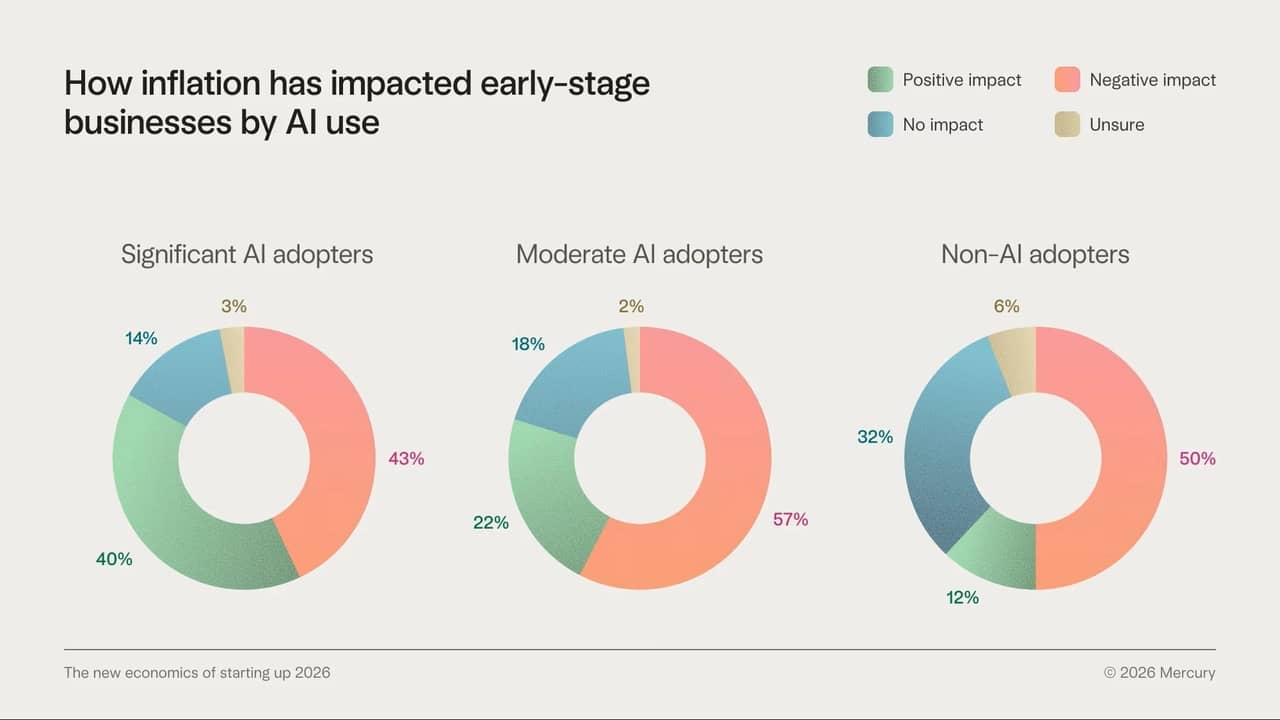
Other influences on founder confidence are factors related to their own business performance (38%) and operational efficiency (24%). And among the small percentage of founders reporting declining confidence, macroeconomic factors were the most cited reason. However, not all founders struggled due to the current macroeconomic environment: 40% of companies that heavily use AI say inflation actually helped their business, compared to just 12% of non-adopters reporting the same. Perhaps AI-powered companies are more able to turn inflationary pressure into an advantage.
Mercury
The AI-powered funding gap
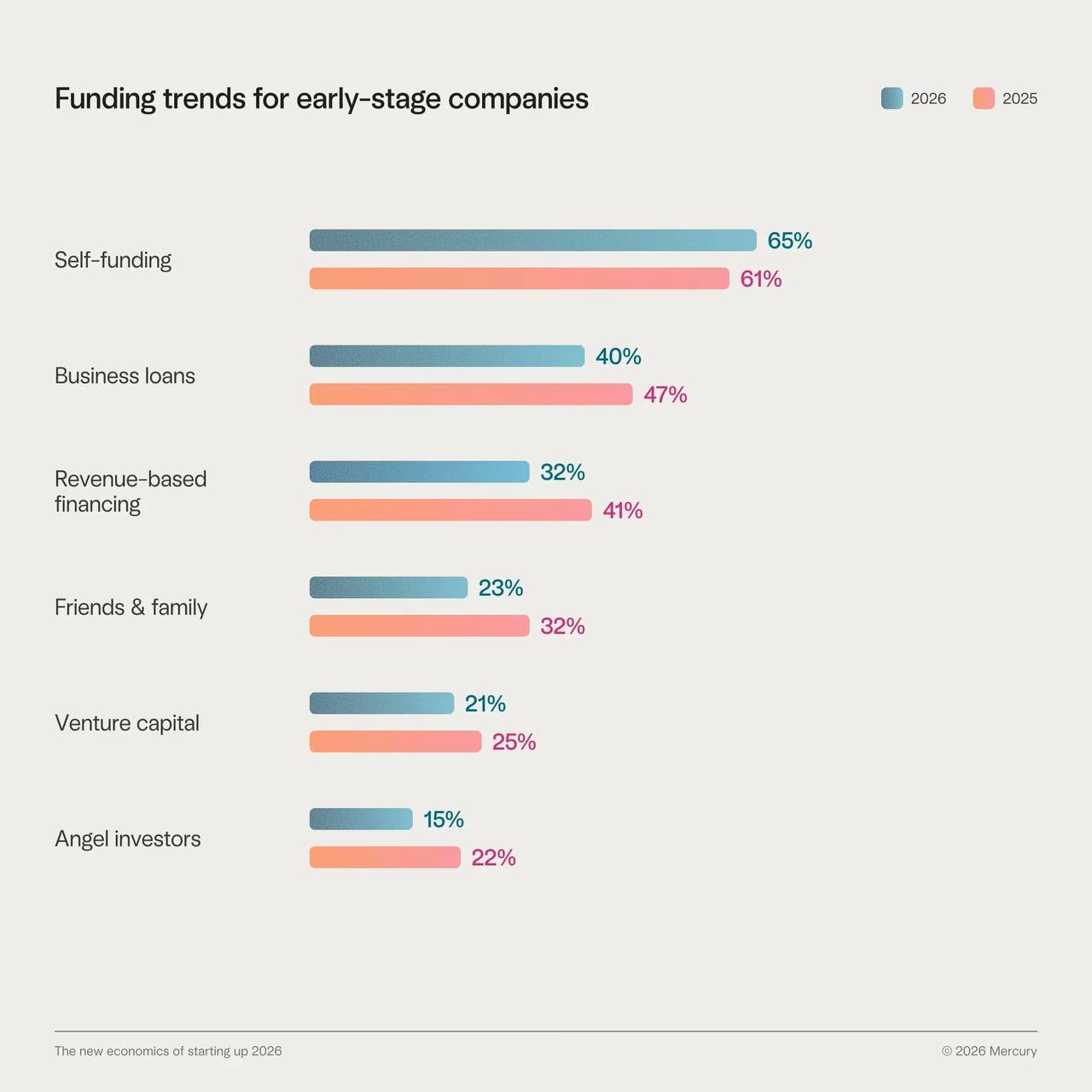
It’s no secret that accessing venture capital got harder this year, and many traditional lenders tightened up, too. Of all the capitalization sources covered in the survey, self-funding was the only one respondents reported more of year over year, climbing from 61% to 65%. Business loans, revenue-based financing, friends and family, angel investment, and venture capital all fell.
Mercury
But that squeeze wasn’t distributed evenly. Significant AI adopters were more than four times as likely to have raised venture capital as non-adopters — 31% versus 7%. And when they raised, they reportedly raised bigger: Among founders who closed a VC round, AI adopters were twice as likely as non-AI adopters to bring in at least $1 million (72% versus 35%).
AI costs may be the price of admission
Seventy-five percent of respondents said running a business cost more than they expected, up from 66% last year. Literally no one said costs came in much lower than expected.
Increasing AI usage comes with its own set of costs. Seventy-seven percent of respondents said AI and token spend increased over the past year, most commonly by 25%-50%. For a small slice of heavy AI users (4%), their costs climbed 200% or more. Spending scales with revenue, too: 30% of $10M-plus companies spend over $25k a month on AI, while 17% of sub-$1M companies spend nothing at all.
However, most founders seem to think their AI spend is worth it. Eighty-five percent said their AI tools delivered better ROI than traditional alternatives, and 87% of those spending on AI are confident they can maintain their current capabilities without raising customer prices or cutting elsewhere.
That confidence comes with a catch. Sixty-five percent of respondents are at least somewhat concerned that AI vendor disruption — a price change, a terms shift, a shutdown — could significantly harm their business, and 29% said more than half their AI reliance sits with a single vendor. Significant AI adopters were three times as likely as lighter adopters to be very concerned. Seems the deeper you build on AI, the more you have riding on someone else’s roadmap.
AI-forward companies are hiring more, not less
It’s probably not time to panic that AI is killing all the jobs:
- 32% of significant AI adopters are actively scaling their teams
- 22% of moderate adopters are doing the same
- Just 12% of non-adopters are
Among companies incorporating AI, 56% say they’re hiring more because of it, and another 38% say it’s letting them hold hiring plans steady. That’s 94% of relevant respondents landing somewhere between neutral and net positive — not exactly doom and gloom.
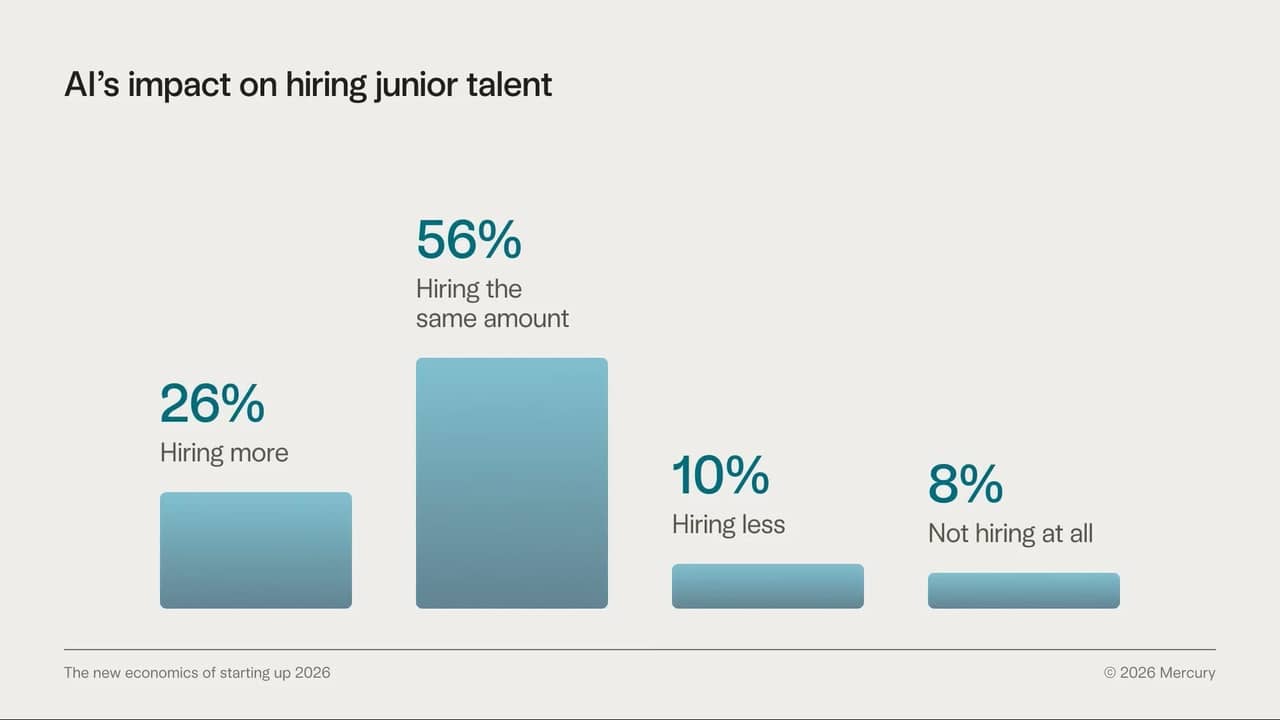
There’s also an overwhelming narrative in the media that AI is replacing junior hires, but the survey data tells a different story. When asked how AI was affecting their hiring of employees with 0-3 years of experience, 26% said they’re hiring more, 56% said about the same, and 10% said less. That means 82% of early-stage companies using AI are bringing on the same number of junior people or more than they would have otherwise. Respondents with significant AI adoption were two times as likely as their counterparts with some adoption to say AI had them hiring more junior talent.
Mercury
What is changing is the shape of the roles. Eighty-two percent of AI adopters have adjusted compensation or role structure because of AI tools, and companies across the board reported:
- Thirty-four percent have made AI fluency a job requirement, spiking to 51% amongst Tech companies
- Twenty-eight percent have shifted some full-time roles to contractor-plus-AI arrangements
- Twenty-five percent are paying lower salaries for roles AI can support, most common in manufacturing (35%) and least common in tech (21%)
For some founders, AI is why the company exists
Fifty-seven percent of respondents said the availability of AI tools played a role in their decision to leave a previous job and start their current business. Perhaps more striking: 31% of founders running $10M-plus companies, the highest revenue cohort in the survey, said AI made starting their business possible at all.
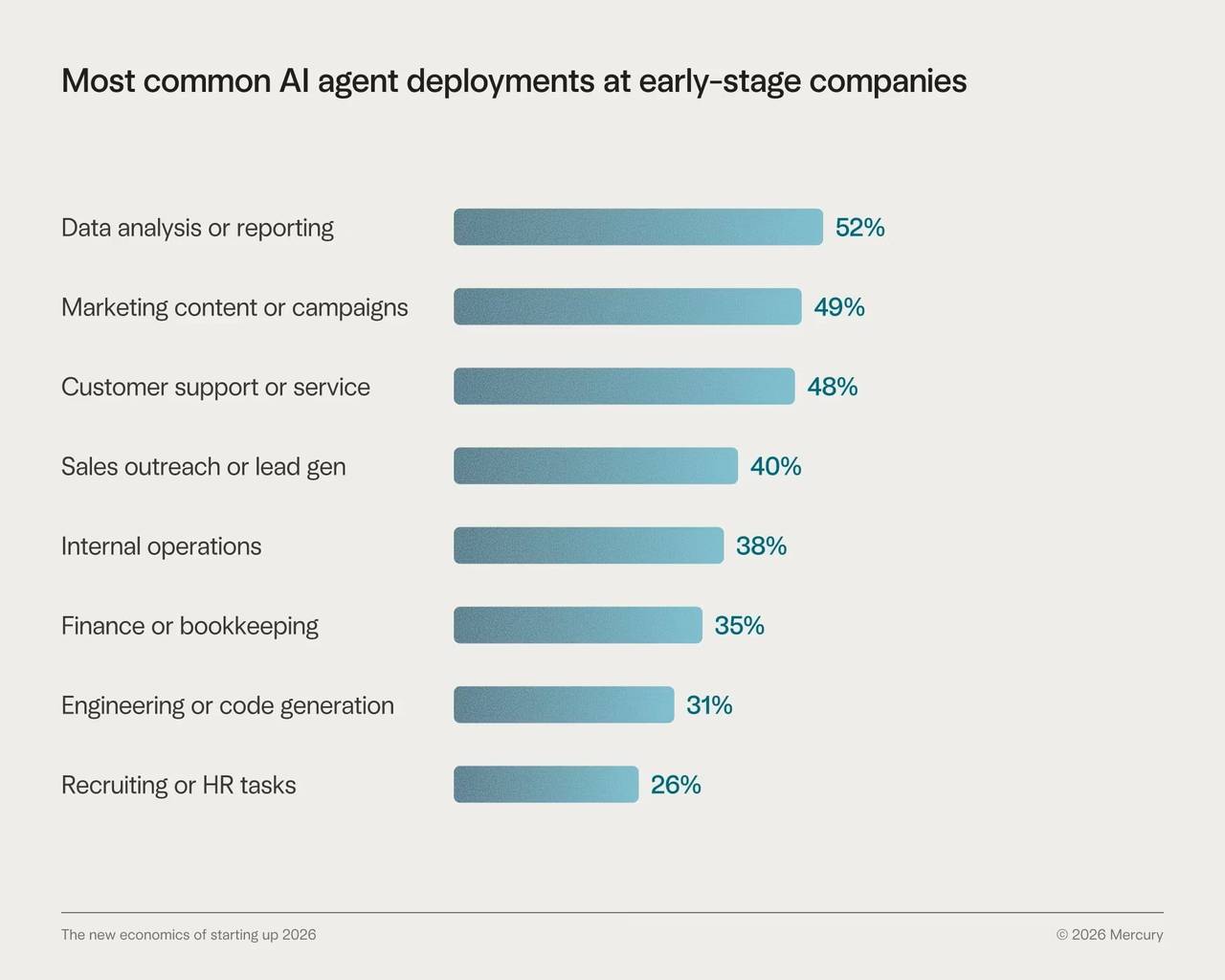
And AI’s effects extend beyond simply starting a company. Nearly everyone is using AI to help run the company, as well. Ninety-five percent of respondents said their company has used AI agents, most often for data analysis and reporting (52%), marketing (49%), and customer support (48%). Once companies passed 100 employees, not a single one reported zero agents deployed.
Mercury
Two economies, one year
Companies going deepest on AI may simply be the ones with the resources and risk appetite to do so, which would explain some of the gaps on their own. But the pattern is hard to wave off. Across confidence, funding, hiring, and how founders describe the macro picture, the split kept landing in the same place. The economics of starting up are being rewritten, and the founders adapting fastest are already working from a different set of numbers than their peers.
Methodology
The New Economics of Starting Up in 2026 report is based on a May 2026 online survey of 1,500 U.S. adults who had been involved in starting a company in the last six years. The sample was provided by Sago, a research panel company. Numbers are rounded to the next whole digit; percentages may not add up to 100%.
* Mercury is a fintech company, not an FDIC-insured bank. Banking services provided through Choice Financial Group and Column N.A., Members FDIC.
This story was produced by Mercury and reviewed and distributed by Stacker.