Shapewear Market: Rising Demand for Body-Contouring Comfort to Drive 5.3% CAGR Through 2035
Shapewear market is projected to reach USD 4.42 billion by 2035, driven by comfort-led innovation, inclusive sizing,
Press Release Disclaimer: This is a press release distributed through the XPR Media network. It has not been independently verified by our newsroom.
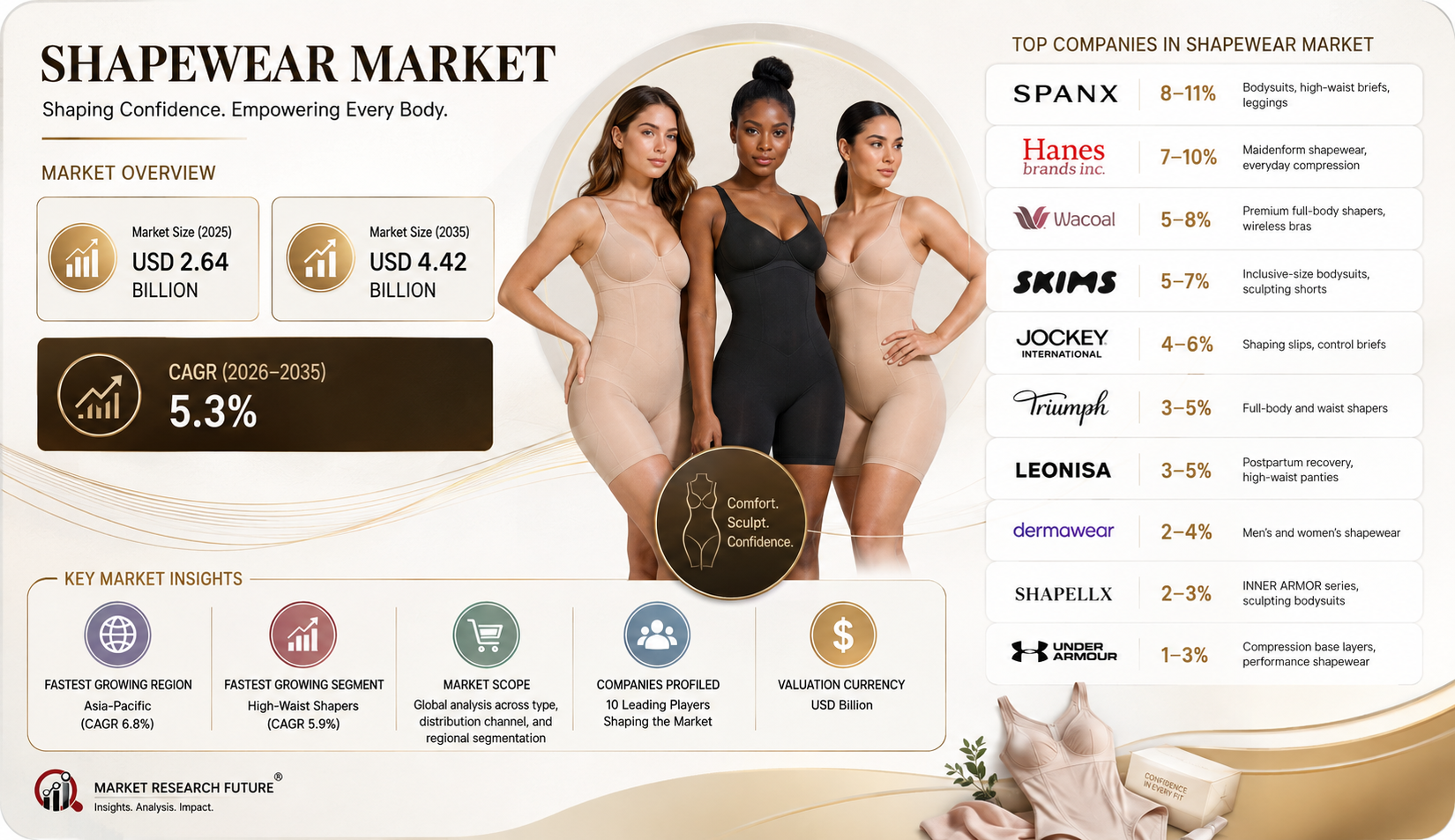

Shapewear market is projected to reach USD 4.42 billion by 2035, driven by comfort-led innovation, inclusive sizing, and rising demand for high-waist designs.
NEW YORK, NY, UNITED STATES, August 26, 2026 /EINPresswire.com/ —
The global shapewear market is entering a period of steady structural growth as consumers increasingly seek garments that combine body contouring, comfort, functionality, and aesthetic appeal. The market, valued at USD 2.64 billion in 2025, is projected to reach USD 4.42 billion by 2035, expanding at a 5.3% CAGR from 2026 to 2035. The market covers a broad product ecosystem spanning briefs, bodysuits, waist shapers, shaping shorts, slips, leggings, and other compression-oriented garments. Unlike earlier generations of shapewear that were often associated with restrictive compression and occasional-use apparel, current demand is increasingly centered on lightweight construction, seamless finishes, breathable fabrics, flexible compression, and inclusive sizing.
Competitive dynamics are becoming more diversified as established intimate-apparel companies compete with digitally native and celebrity-led brands. Spanx, with an estimated 8–11% revenue share, remains a major category pioneer through bodysuits, high-waist briefs, and leggings. Hanesbrands Inc. follows at 7–10%, supported by Maidenform and extensive retail distribution. Wacoal Holdings Corp. holds an estimated 5–8%, while SKIMS accounts for approximately 5–7%, emphasizing inclusive sizing and direct-to-consumer distribution. Other notable participants include Jockey International, Triumph International, Leonisa, Dermawear, Shapellx, and Under Armour, creating a competitive landscape that ranges from heritage intimate-wear specialists to innovation-focused digital brands.
Free Sample Copy – Access A Complimentary Copy of Our Report to Explore Its Content and Insights
https://www.marketresearchfuture.com/sample_request/7273
Key Market Drivers
One of the most important growth drivers is the changing consumer perception of shapewear. The category is increasingly positioned as an everyday apparel solution rather than merely an undergarment used for special occasions. Consumers are looking for products that can be worn under workwear, dresses, casual clothing, activewear, and occasionwear. This shift is encouraging manufacturers to develop softer textiles, improved ventilation, low-profile seams, and flexible structures that maintain shaping performance without creating excessive pressure.
The expansion of body-positive fashion and inclusive sizing is another important factor. Consumers across different body shapes and age groups increasingly expect brands to provide broader size ranges and more varied silhouettes. SKIMS, for example, has built its product strategy around multiple body types and compression levels, while brands such as Leonisa and Dermawear emphasize localized fit and specialized requirements. This movement is expanding the addressable consumer base and encouraging companies to treat fit engineering as a central competitive advantage.
E-commerce is also changing purchasing behavior. Digital channels enable brands to provide detailed size guides, compression-level descriptions, product demonstrations, reviews, and personalized recommendations. Direct-to-consumer companies can rapidly test new silhouettes and respond to customer feedback, while established players continue to benefit from department stores, specialty retailers, supermarkets, and apparel chains.
Segment Analysis: Type
High-waist shapers represent the fastest-growing product segment, with a projected 5.9% CAGR. Their popularity is closely linked to versatility because they can target the abdomen, waist, hips, and lower back while remaining relatively easy to integrate with everyday outfits. High-waist briefs and shorts are particularly attractive to consumers seeking targeted midsection control without the coverage of a full bodysuit.
Bodysuits occupy another significant position because they provide more comprehensive shaping across the torso, waist, hips, and sometimes thighs. Innovation in open-bust designs, adjustable straps, seamless construction, and flexible compression is improving usability. Bodysuits are particularly relevant for formalwear, occasionwear, and fitted clothing.
Waist shapers and cinchers remain relevant for consumers seeking concentrated waist definition. However, manufacturers are increasingly balancing strong compression with breathability and movement. This is gradually shifting the segment away from rigid constructions toward flexible materials and engineered compression zones.
Shaping briefs and panties appeal to consumers looking for subtle, localized control. Their lower coverage makes them suitable for daily use and allows integration with a wider variety of clothing. Shaping shorts and leggings are also gaining relevance because they combine smoothing with thigh support and, in some cases, activewear functionality.
Segment Analysis: Distribution Channel
The online distribution channel is becoming increasingly important because shapewear requires consumers to compare sizes, compression levels, fabrics, and body coverage before purchasing. Brand websites and marketplaces offer extensive product information and allow companies to reach consumers beyond traditional retail territories.
Offline channels nevertheless remain important. Department stores, specialty intimate-wear retailers, apparel stores, and other physical outlets allow consumers to evaluate fit and fabric directly. Established companies such as Hanesbrands, Jockey, Wacoal, and Triumph benefit from longstanding retail relationships. Consequently, an omnichannel model is likely to remain central to the market rather than digital commerce completely replacing physical retail.
Regional Analysis
Asia-Pacific is the fastest-growing regional market, registering a projected 6.8% CAGR. Growth is supported by expanding urban populations, increasing disposable income, greater fashion consciousness, and broader adoption of intimate apparel through organized retail and e-commerce. Localized sizing and product development are particularly important because body proportions, climate conditions, and clothing preferences vary considerably across the region.
North America remains a highly developed market, supported by strong brand recognition, established shapewear categories, and high consumer familiarity with compression garments. Europe also represents an important market, with companies such as Triumph contributing to regional distribution and product innovation. Latin America has particular potential through specialized players such as Leonisa, which has developed products around regional preferences and localized sizing.
Competitive Landscape and Key Players
Competition is increasingly based on fabric technology, compression control, fit accuracy, inclusivity, brand identity, distribution reach, and product innovation rather than compression strength alone. Spanx continues to differentiate itself through engineered compression and product development. Hanesbrands leverages mass-market reach, while Wacoal combines intimate-wear expertise with premium positioning. SKIMS emphasizes celebrity-driven demand, inclusive sizing, and DTC distribution.
Jockey International benefits from brand heritage and retail relationships, whereas Triumph has established penetration across European and Asian markets. Leonisa maintains a strong position in Latin America, particularly in postpartum and high-waist products. Dermawear brings an India-focused approach, while Shapellx emphasizes innovation and sustainability. Under Armour provides a crossover between shapewear and performance compression, targeting fitness-oriented consumers.
Proceed To Buy – Move Forward with Your Purchase and Gain Instant Access to the Complete Report
https://www.marketresearchfuture.com/checkout?currency=one_user-USD&report_id=7273
Industry Developments
1. Advanced compression technology is moving toward lighter construction. In February 2026, Spanx introduced its SPANXsculpt GoFigure collection, using strategically positioned LYCRA FitSense technology for 360-degree sculpting while reducing reliance on bulky traditional construction. The development reflects a broader industry movement toward targeted compression, seamless aesthetics, and improved wearability.
2. Comfort-oriented materials are becoming a product differentiator. Spanx launched its Invisible Supima Cotton collection in 2025, combining shaping technology with breathable Supima cotton and moisture-management characteristics. The development illustrates how manufacturers are attempting to reconcile compression performance with softness and everyday comfort.
Future Outlook
The shapewear market is expected to maintain consistent expansion through 2035 as manufacturers move toward multifunctional products that combine shaping, comfort, support, and fashion. The strongest opportunities are likely to emerge from high-waist products, inclusive sizing, lightweight compression, seamless construction, breathable fabrics, and digitally enabled fitting experiences.
The market’s 5.3% CAGR through 2035 indicates sustained rather than purely trend-driven expansion. At the same time, competition will increasingly depend on the ability of brands to deliver measurable product differentiation. Companies that successfully combine compression engineering with comfort, size inclusivity, localized fit, sustainable materials, and omnichannel availability are likely to strengthen their positions as shapewear becomes increasingly integrated into everyday wardrobes.
FAQs
1. What is driving the growth of the shapewear market?
Key drivers include increasing demand for comfortable everyday shaping, inclusive sizing, product innovation, e-commerce expansion, and growing consumer interest in versatile compression garments.
2. Which is the fastest-growing segment of the shapewear market?
High-waist shapers are the fastest-growing segment, projected to expand at a 5.9% CAGR, supported by demand for versatile abdominal, waist, hip, and lower-back shaping.
Read Our Related Research Report
Sustainable Apparel Market –
https://www.marketresearchfuture.com/reports/sustainable-apparel-market-25341
Outdoor Performance Apparel Market –
https://www.marketresearchfuture.com/reports/outdoor-performance-apparel-market-9436
Luxury Apparel Market –
https://www.marketresearchfuture.com/reports/luxury-apparel-market-11938
Functional Apparels Market –
https://www.marketresearchfuture.com/reports/functional-apparels-market-7074
Horse Riding Apparel Market –
https://www.marketresearchfuture.com/reports/horse-riding-apparel-market-33778
Sagar Kadam
Market Research Future
+1 628-258-0071
email us here
Legal Disclaimer:
EIN Presswire provides this news content “as is” without warranty of any kind. We do not accept any responsibility or liability
for the accuracy, content, images, videos, licenses, completeness, legality, or reliability of the information contained in this
article. If you have any complaints or copyright issues related to this article, kindly contact the author above.

Media gallery