Vadzo Imaging Launches Bolt-2020CRH: 20MP Color Autofocus MIPI CSI-2 Camera with Low Power Operation and Dynamic ROI for Autonomous Mobile Robots
Built for autonomous mobile robots that must navigate, detect obstacles, and map their environment for hours on a
Press Release Disclaimer: This is a press release distributed through the XPR Media network. It has not been independently verified by our newsroom.

Built for autonomous mobile robots that must navigate, detect obstacles, and map their environment for hours on a single battery charge, this camera pairs the Onsemi AR2020 sensor with VCM autofocus, Dynamic ROI, and low-power operation over MIPI CSI-2, giving AMR manufacturers genuine 20MP vision without the power draw of a camera not built for mobile robotics.
FORT WORTH, TX / ACCESS Newswire / August 26, 2026 / Vadzo Imaging, a provider of embedded vision solutions, today launched the Bolt-2020CRH, a 20MP Color Autofocus MIPI Camera built around the Onsemi AR2020 color sensor for autonomous mobile robots, warehouse robotics, and mobile navigation platforms that need detailed vision without a matching increase in power draw.
Why Autonomous Mobile Robots Need a 20MP Autofocus MIPI Camera Built for Battery-Powered Operation
Autonomous mobile robots operate under a power budget that a fixed industrial camera never has to consider. Every watt a camera draws is a watt not available to the drive motors, the compute platform running navigation and obstacle detection, or the battery runtime between charges, which makes camera power draw a genuine engineering trade-off a manufacturer has to weigh carefully rather than an afterthought. An AR2020 Autofocus Camera that delivers excellent image quality but draws power like a stationary machine vision system forces an AMR manufacturer to accept reduced operating time or a larger, heavier battery to compensate.
A 20MP Dynamic ROI MIPI Camera approaches that problem alongside a second, related challenge: resolving both a wide navigation view and a specific obstacle or marker quickly enough to support real-time robot decision-making. A Dynamic ROI Low Power Camera configuration reads out a smaller region at a higher frame rate when a robot’s navigation software needs to track a specific obstacle or feature closely, without the cost of processing a full frame at that same rate.
A third challenge is resolving detail at the range of distances a mobile robot actually encounters while navigating a warehouse or facility, from a marker directly ahead to a feature well across an open aisle. A Low Power Autofocus MIPI Camera solves that problem electronically, adjusting focus as a robot moves rather than requiring a fixed focus setting tuned for one assumed operating distance.
None of these three challenges- power budget, obstacle response time, and focus across varying distances- exist independently on a real robot. A camera that solves power efficiency but cannot keep a moving obstacle in focus is not actually safer to deploy, and a camera with excellent focus and obstacle response that drains the battery too quickly limits how long that safety benefit can actually run. Addressing all three from the same sensor platform is what makes a camera genuinely suited to autonomous mobile robotics rather than merely adequate on any single specification.
Engineering Explanation: Resolution, Focus, and Power Efficiency Together
Onsemi designed the AR2020 to deliver 20 megapixel resolution without the power draw typically associated with a sensor of this pixel count, which matters directly for a mobile robot budgeting power across drive, compute, and sensing systems simultaneously. As an AR2020 Low Power MIPI Sensor, the sensor gives AMR manufacturers genuine high-resolution vision without treating power efficiency as a secondary concern.
That resolution works alongside VCM autofocus to resolve the actual range of distances a mobile robot encounters while navigating. As an AR2020 VCM Autofocus MIPI Camera, the Bolt-2020CRH adjusts focus electronically as a robot moves through a facility, keeping navigation markers, obstacles, and mapped features in focus regardless of how far the robot happens to be from them at any given moment. A Low Power MIPI Autofocus Module configuration like this one gives robotics integrators that focus flexibility without the added power cost a less efficient autofocus implementation might introduce.
Dynamic ROI extends the sensor’s usefulness for real-time robotics decision-making. As a 20MP VCM Autofocus MIPI Camera, the AR2020 can be configured to read out a smaller, defined region of the sensor at a substantially higher frame rate than a full frame capture would allow, which matters directly for obstacle detection and tracking tasks that need fast, localized updates without the bandwidth and processing cost of full frame capture at every cycle. A 20MP ROI Autofocus Camera configuration like this one gives AMR navigation software the responsiveness it needs for real-time obstacle avoidance.
Delivering all of this over MIPI CSI-2 is the final piece of the design. As an Onsemi AR2020 Autofocus MIPI Camera, the Bolt-2020CRH connects directly to the MIPI CSI-2 interface already built into most embedded compute platforms used in mobile robotics, avoiding the additional power draw and complexity a USB or networked interface would introduce into an already power-constrained robotic platform. A 20MP MIPI Autofocus Sensor configuration like this one keeps the camera’s contribution to the robot’s overall power budget as small as its contribution to the robot’s vision capability is large.
Product Overview
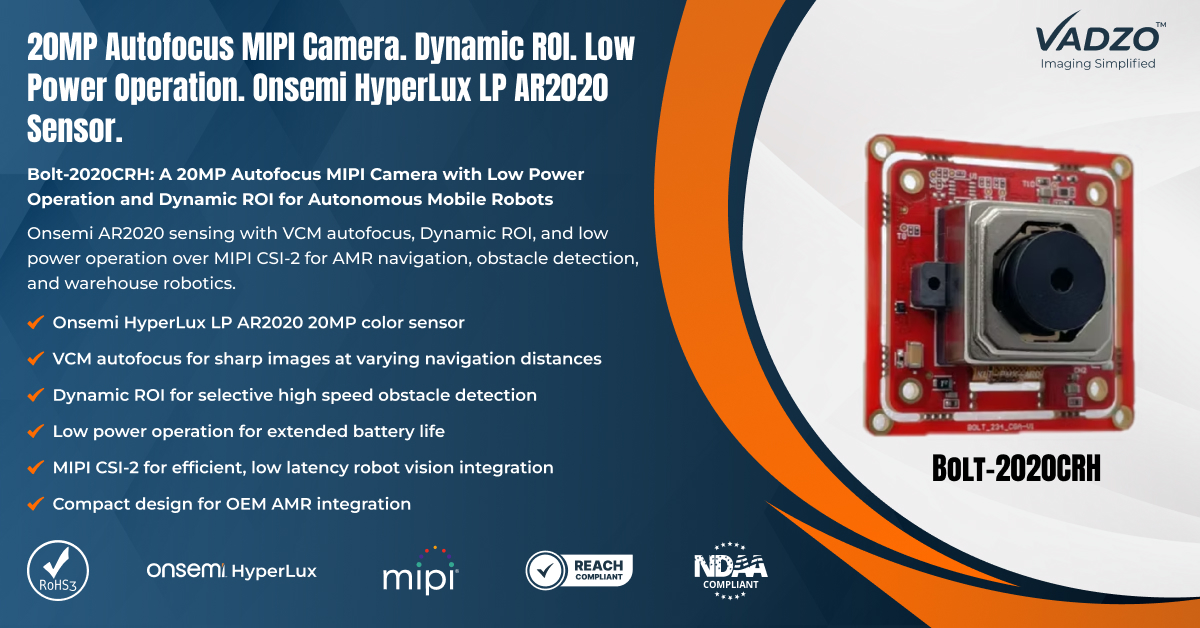
The Bolt-2020CRH pairs the AR2020 Color Autofocus MIPI Camera sensor with VCM autofocus, Dynamic ROI, and low power operation in a compact design suited to AMR, warehouse robot, and mobile navigation platform integration. As a 20MP Autofocus MIPI Camera, it outputs full 20-megapixel resolution with autofocus and power-efficient processing active by default, giving AMR manufacturers a single camera platform that covers navigation, obstacle detection, and general-purpose mobile robot vision from one module.
At the core of the module sits the Onsemi AR2020 20MP Sensor, chosen specifically for the combination of resolution, autofocus range, and power efficiency that battery-powered robotics platforms require. Because the camera pairs 20MP Low Power MIPI Camera sensitivity with 20MP MIPI ROI Camera navigation flexibility, the Bolt-2020CRH reaches usable image quality across a facility’s varied lighting and distances while drawing meaningfully less average power than a camera not built around that specific efficiency goal.
Product Specifications
Key specs: 20MP (5120 × 3840) Max Resolution | Onsemi AR2020, 1/1.8-inch | 1.4 µm Pixel | Color, Rolling Shutter | MIPI CSI-2 Interface | S Mount (M12 Standard) with VCM Autofocus Optics
Key Capabilities
Onsemi AR2020 Sensor for Detailed 20MP Robotic Vision: The Bolt-2020CRH is built around the Onsemi AR2020 sensor, a device that resolves fine detail across a robot’s full navigation view rather than cropping or subsampling to reach a marketing resolution number. This gives the module genuine 20MP MIPI Sensor Module performance suited to AMR applications that need to identify a small navigation marker at distance while also resolving a nearby obstacle in the same frame. That combination matters because a robot navigating a real facility encounters both situations constantly and rarely gets to choose which one to prioritize at any given moment.
VCM Autofocus for Sharp Images Across Varying Navigation Distances: A mobile robot’s distance to whatever it is navigating toward or avoiding changes constantly as it moves through a facility, which makes a fixed focus lens a real limitation for robotics vision. The included VCM autofocus lens assembly adjusts electronically as that distance changes, keeping navigation markers and obstacles in sharp focus whether the robot is approaching a nearby shelf or scanning an open aisle several meters ahead.
Dynamic ROI for Selective High-Speed Obstacle Detection: Not every navigation task requires processing the full sensor’s field of view at maximum resolution, and reading out the entire array when only a specific obstacle or marker actually needs fast tracking wastes both bandwidth and the processing time a robot’s navigation software needs for real-time decisions. The Bolt-2020CRH lets integrators define a smaller readout region that streams at a meaningfully higher frame rate, which matters directly for obstacle avoidance systems where response time affects robot safety. A robot that can shift to a fast, targeted readout the moment an obstacle is identified responds meaningfully faster than one still processing a full frame at a fixed rate, which can be the difference between a smooth course correction and an abrupt stop.
Low Power Operation for Extended Battery Life: Every watt a camera draws on a mobile robot is a watt unavailable to drive motors or compute hardware, which makes camera power efficiency a genuine contributor to a robot’s total operating time between charges. As a Low Power MIPI Camera Module, the Bolt-2020CRH is engineered specifically to minimize that power draw, giving AMR manufacturers meaningful high-resolution vision without a corresponding reduction in battery runtime.
MIPI CSI-2 for Efficient, Low Latency Robot Vision Integration: Most embedded compute platforms used in autonomous mobile robots already include a native MIPI CSI-2 interface, which makes a MIPI-connected camera a more direct and power-efficient fit than a USB or networked camera requiring additional controller hardware. As an MIPI CSI-2 AMR Camera, the Bolt-2020CRH connects directly to that existing interface, reducing both the bill of materials and the power budget of a robot’s vision system integration. As an HDR MIPI Camera Module, it also fits directly into Vadzo Imaging’s broader MIPI camera portfolio for integrators comparing dynamic range and connectivity options across product lines.
Compact OEM-Ready Design for AMR Integration: AMR and robotics manufacturers producing units at scale need a camera platform that stays consistent across a long production run. Vadzo Imaging supports full customization on this platform as an AMR Embedded Camera Manufacturer, including connector changes, optics selection, and firmware adjustments for manufacturers headed into volume production across multiple robotics product lines. That customization extends to power profile tuning as well, since a manufacturer building a small indoor AMR may need a different balance of resolution and power draw than one building a larger outdoor platform, even though both rely on the same underlying sensor.
“AMR manufacturers keep telling us the same thing: a camera that delivers great image quality but drains the battery meaningfully faster is not actually a win for the robot overall. The AR2020’s low-power operation combined with VCM autofocus and Dynamic ROI gives the Bolt-2020CRH genuine 20 megapixel vision without asking a robot to sacrifice runtime for image quality. We built this camera for robots that need to work a full shift, not just look good in a demo.” – Alwin Vincent, Product Manager at Vadzo Imaging.
Application-Specific Sections
Autonomous Navigation and SLAM: Autonomous navigation and simultaneous localization and mapping systems need vision that resolves both wide environmental features and specific navigation markers with enough detail for accurate mapping. As an AMR SLAM Camera, the Bolt-2020CRH’s 20 megapixel resolution supports mapping accuracy, and functioning as a Robotic Autonomy MIPI Camera, it extends the same capability to broader autonomous decision-making tasks beyond mapping alone.
Obstacle Detection and Avoidance: Obstacle detection and avoidance systems need fast, reliable identification of objects in a robot’s path, often requiring quick, localized examination of a specific region rather than constant full frame processing. As an AMR Obstacle Detection Camera, the Bolt-2020CRH’s Dynamic ROI supports that fast, targeted detection, and a Robot Navigation MIPI Camera configuration of the same module extends the same responsiveness to general path planning and navigation decisions.
Warehouse and Logistics Robotics: Warehouse and logistics robots operating across large facility footprints need vision that performs consistently whether navigating a wide open aisle or a tightly packed storage area. As a Warehouse Robot Camera Module, the Bolt-2020CRH supports that range, and functioning as an AMR Camera Module, it fits directly into standard AMR integration workflows already built around this class of vision hardware.
Mobile Robot Vision for Industrial Automation: Mobile robots operating alongside fixed industrial automation equipment need vision that integrates cleanly with existing embedded compute platforms already common on a factory floor. A Mobile Robot Vision Sensor platform like this one gives industrial automation integrators that compatibility, and as an Autonomous Mobile Robot Camera, it extends that same integration to dedicated AMR platforms working alongside fixed automation equipment on the same factory floor. That shared compatibility matters for facilities running a mix of fixed and mobile automation, since standardizing on compatible vision hardware across both categories simplifies integration, spare parts inventory, and long-term maintenance planning.
OEM Integration for AMR Manufacturers: AMR manufacturers building their own robotics platforms need a camera vendor who understands the power, resolution, and connectivity requirements those platforms demand. The Bolt-2020CRH ships with those requirements built in from the start, and Vadzo Imaging supports OEM customization for cable length, connector type, and firmware for manufacturers standardizing on one camera across multiple robotics product lines. As an AMR Vision Camera, it fits directly into a manufacturer’s existing robotics platform architecture.
Frequently Asked Questions
Q: Why does an autonomous mobile robot need 20MP resolution for navigation when most robots move relatively slowly?
A: Navigation speed and resolution requirements are not directly related, since a robot moving slowly still needs to identify small navigation markers, distant obstacles, or subtle floor features accurately enough to make correct decisions, regardless of how quickly it is physically moving. A lower resolution camera forces a robot to either operate at closer range to compensate for reduced detail, which limits its effective field of view, or accept less reliable identification of small or distant features. Vadzo Imaging’s higher resolution camera products, such as the Bolt-2020CRH’s 20 megapixel Onsemi AR2020 sensor, give AMR manufacturers the pixel density needed for reliable feature identification across a genuinely useful navigation range, rather than forcing a compromise between resolution and coverage area.
Q: Why does battery-powered robot vision need to consider camera power draw as carefully as motor and compute power draw?
A: A mobile robot’s total operating time between charges depends on the combined power draw of every subsystem working together, not just the most obviously power-hungry components like drive motors and compute hardware. A camera that draws more power than necessary meaningfully reduces that total operating time just as surely as an inefficient motor would, even though a camera’s power draw is often smaller in absolute terms. Vadzo Imaging designs its robotics camera products around genuine power efficiency specifically because every subsystem’s contribution to a robot’s total power budget matters, and a vision system should not be the overlooked factor that quietly shortens a robot’s working shift. Manufacturers evaluating a camera should request power draw figures under continuous operation rather than only peak or idle measurements, since a robot’s camera is typically active throughout its entire working shift rather than cycling on and off.
Q: What is dynamic region of interest readout, and why would an AMR need it for obstacle detection specifically?
A: Dynamic region of interest readout lets a camera capture a smaller, defined portion of its full sensor array at a significantly higher frame rate than reading out the entire frame would allow, while retaining full resolution capture when a wider view is needed. For obstacle detection, that flexibility means a robot’s navigation software can track a specific object closely at high speed once it has been identified, without the bandwidth and processing cost of full frame capture at every cycle slowing down the response time that robot safety actually depends on. Vadzo Imaging builds this capability into its robotics camera products, such as the Dynamic ROI featured on the Bolt-2020CRH, because obstacle avoidance decisions often need to happen faster than a full frame processing cycle would otherwise allow.
Q: Can Vadzo Imaging customize a low power MIPI camera module for a specific AMR or robotics platform?
A: Yes. Vadzo Imaging supports full OEM customization across its robotics camera portfolio, including optics selection suited to a specific navigation range, connector and cable configuration matched to a particular embedded compute platform, and firmware adjustments tuned for a specific power profile or Dynamic ROI configuration. Evaluation units ship with no minimum order requirement, and the same engineering team that built the standard product works directly with AMR manufacturers to adapt the module for a specific navigation, obstacle detection, or mapping platform headed into volume production.
Q: What should AMR and robotics manufacturers look for when choosing a camera supplier for a battery-powered navigation platform?
A: A camera that performs well on a bench connected to unlimited power does not necessarily perform the same way once integrated into a robot’s actual power budget, since power draw during continuous navigation operation matters just as much as raw image quality specifications. Manufacturers should look for genuine low-power design validated during real navigation workloads rather than only idle conditions, a connectivity approach that matches the embedded compute platform already used in the robot, and a supplier able to support customization for a specific navigation or obstacle detection requirement. Vadzo Imaging builds its robotics camera products, including the low-power Bolt-2020CRH, around exactly these priorities, since a camera that only performs well in isolation is not necessarily a good fit once integrated into a robot’s complete power and compute budget.
Availability
The Bolt-2020CRH 20MP Autofocus MIPI Camera is available now and ready for evaluation and OEM integration. Evaluation kits include the camera module, a factory-calibrated autofocus lens, and integration documentation covering Dynamic ROI configuration and low power mode setup, with no minimum order requirement. Contact Vadzo Imaging at support@vadzoimaging.com to request an evaluation unit or discuss volume production and OEM customization. Evaluation feedback is also welcome directly through the same contact channel, since real deployment conditions across a pilot robotics platform often surface details a bench test alone would not reveal, and that feedback helps confirm a configuration before a manufacturer commits to a full production order.
About Vadzo Imaging
Vadzo Imaging develops embedded and machine vision camera products for OEMs, system integrators, and AMR manufacturers building production-ready vision systems across autonomous robotics, industrial automation, warehouse logistics, and edge AI. The company’s portfolio spans MIPI CSI-2, USB, GigE, Wi-Fi, FPD-Link III, and SerDes interface camera products, supporting deployment architectures from compact onboard modules to distributed networked installations. Vadzo provides end-to-end imaging support, including sensor integration, ISP tuning, firmware development, and SDK frameworks to accelerate system deployment, and the company’s engineering team works directly with customers throughout evaluation, pilot deployment, and volume production rather than handing off support after the initial sale. That ongoing engineering relationship matters most for robotics programs, where a camera platform may remain in service across an entire fleet of mobile robots for years after initial deployment. Visit Vadzo Imaging to explore the full embedded vision camera portfolio.
Media Contact
Alwin Vincent
Vadzo Imaging
Email: alwin@vadzoimaging.com
LinkedIn: Vadzo Imaging
YouTube: Vadzo Imaging
X: Vadzo Imaging
SOURCE: Vadzo Imaging
View the original press release on ACCESS Newswire
Media gallery