
Automotive Camera Market to Reach USD 24.38 Billion by 2035, Growing at 10.0% CAGR
Automotive Camera Market is projected to reach USD 10.34 billion in 2026, expanding to USD 24.38 billion by 2035 NEW
Press Release Disclaimer: This is a press release distributed through the XPR Media network. It has not been independently verified by our newsroom.
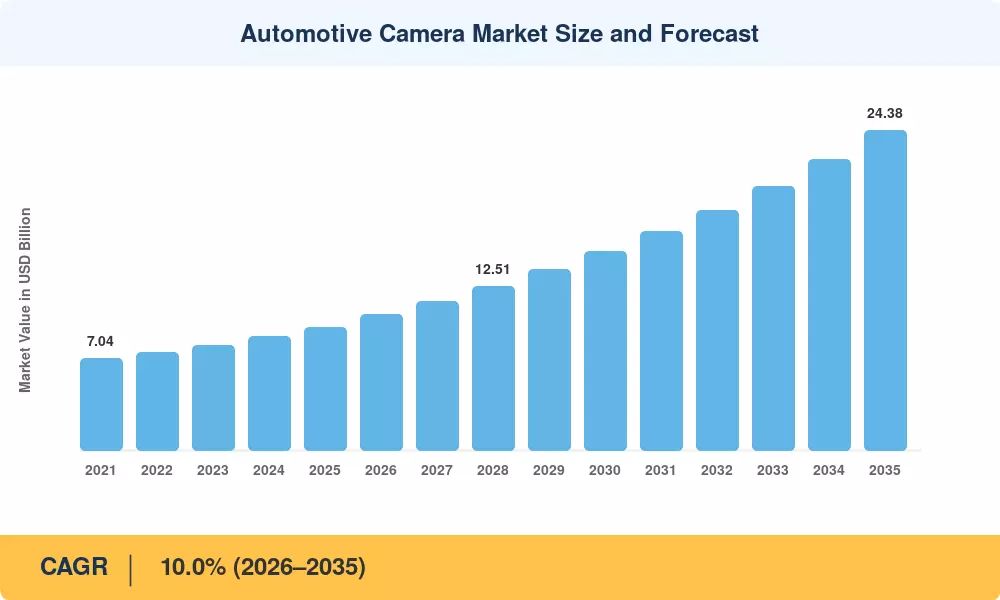

Automotive Camera Market is projected to reach USD 10.34 billion in 2026, expanding to USD 24.38 billion by 2035
NEW YORK, NY, UNITED STATES, August 21, 2026 /EINPresswire.com/ — According to a study from Market Research Future, Automotive Camera Market is projected to reach USD 10.34 billion in 2026, expanding to USD 24.38 billion by 2035 at a compound annual growth rate of 10.0% during the forecast period (2026–2035).
Market Overview
The Automotive Camera Market encompasses a rapidly expanding segment of the automotive industry dedicated to the development, manufacturing, and integration of camera systems used in vehicles for various safety, convenience, and autonomous driving applications. Automotive cameras are sophisticated imaging devices that capture visual information from the vehicle’s surroundings, processing this data through advanced algorithms to enable critical functions ranging from parking assistance and surround-view monitoring to advanced driver assistance systems (ADAS) and autonomous driving capabilities. These cameras are deployed in various positions around the vehicle, including front-facing, rear-facing, side-mount, and interior configurations, each serving specific purposes in enhancing vehicle safety and operational efficiency.
The market’s exceptional growth trajectory is underpinned by several powerful drivers. The most significant driver is the global push toward enhanced vehicle safety, with governments and regulatory bodies worldwide mandating the inclusion of camera-based safety systems in new vehicles. The increasing adoption of ADAS features, which rely heavily on camera inputs for functions such as automatic emergency braking, lane departure warning, and adaptive cruise control, has dramatically expanded the demand for automotive cameras. Furthermore, the progression toward autonomous vehicles has created unprecedented demand for high-performance camera systems capable of providing the comprehensive environmental perception required for self-driving operations.
Several significant industry trends are reshaping the Automotive Camera landscape. The trend toward higher resolution cameras with enhanced imaging capabilities is accelerating, with manufacturers moving from standard definition to high definition and even 4K resolution cameras to provide clearer, more detailed images for both human viewing and machine vision applications. The integration of artificial intelligence and machine learning algorithms directly into camera systems is enabling more sophisticated image processing at the edge, reducing latency and improving system responsiveness. The consolidation of multiple camera functions into single devices represents another trend, with manufacturers developing multi-function camera modules that combine various capabilities while reducing cost, weight, and packaging requirements.
Technological developments in the automotive camera sector are advancing at remarkable speed. CMOS (Complementary Metal-Oxide-Semiconductor) imaging sensors continue to evolve, offering improved sensitivity, dynamic range, and low-light performance, making them the dominant technology in automotive applications. The emergence of event-based cameras, which only transmit changes in the visual scene rather than entire frames, offers potential advantages in terms of reduced data processing requirements and improved performance in challenging lighting conditions. Thermal (Longwave Infrared) cameras and Near-Infrared (NIR) cameras are gaining traction in advanced applications, enabling vision in complete darkness and through fog and smoke, enhancing vehicle safety in adverse conditions. Furthermore, advances in camera cleaning systems, including integrated washer nozzles and hydrophobic coatings, are addressing the challenge of maintaining clear vision in adverse weather conditions.
Government policies and regulatory frameworks play a crucial role in shaping the Automotive Camera market. Regulatory mandates requiring rear-view cameras in new vehicles in major markets such as the United States and Europe have established a baseline demand for automotive cameras. The increasing regulatory focus on driver monitoring systems, particularly in Europe where the General Safety Regulation mandates the inclusion of driver drowsiness and attention warning systems in new vehicles from 2024, has created significant growth opportunities for interior camera systems. Additionally, regulatory frameworks concerning vehicle safety ratings, such as Euro NCAP and NHTSA’s New Car Assessment Program, incentivize the adoption of camera-based safety features by providing favorable safety ratings for vehicles equipped with such systems.
The demand outlook for automotive cameras remains exceptionally strong, with projections indicating sustained double-digit growth throughout the forecast period. The increasing complexity of ADAS systems, the transition toward higher levels of vehicle autonomy, and the expanding application of camera technology beyond safety into areas such as in-cabin monitoring and commercial vehicle applications are all contributing to robust demand growth. While passenger vehicles represent the largest market segment, commercial vehicle applications are emerging as a significant growth area, with fleet operators increasingly adopting camera-based systems to enhance safety, reduce accidents, and improve operational efficiency.
📍 Get Free Sample Report for Detailed Market Insights:
https://www.marketresearchfuture.com/sample_request/2948
Market Segmentation
The Automotive Camera Market is comprehensively segmented to provide detailed insights into the various aspects of this dynamic and rapidly evolving industry.
By Vehicle Type: The market is categorized into Passenger Vehicles, Light Commercial Vehicles, and Heavy Commercial Vehicles. Passenger vehicles represent the largest market segment, driven by the high volume of passenger car production and the increasing penetration of camera-based safety and convenience features across all vehicle classes. Light commercial vehicles are experiencing growing camera adoption, particularly for rear-view and surround-view applications that improve safety in urban delivery environments. Heavy commercial vehicles represent a significant growth segment, with camera systems being deployed for improved visibility, driver assistance, and fleet management applications. The adoption of camera-based mirror replacement systems in commercial vehicles is an emerging trend that promises to improve aerodynamics, reduce blind spots, and enhance safety.
By Camera Technology: The market encompasses Digital (CMOS) cameras, which dominate the market due to their excellent image quality, low power consumption, and cost-effectiveness. Thermal (LWIR) cameras detect heat signatures and enable vision in complete darkness and through obstructions such as fog and smoke, making them increasingly valuable for advanced safety and autonomous driving applications. Near-Infrared (NIR) cameras are used in night vision systems and driver monitoring applications, providing enhanced vision in low-light conditions. Other technologies include CCD (Charge-Coupled Device) sensors and emerging Event-Based cameras, which represent specialized solutions for specific applications where traditional CMOS technology may face limitations.
By Application: The market is segmented into ADAS applications including Automatic Emergency Braking (AEB), Lane Departure Warning (LDW), and Adaptive Cruise Control (ACC), which represent the largest and fastest-growing application area. Park Assist systems utilize cameras to provide drivers with enhanced visibility during parking maneuvers. Driver Monitoring Systems use interior-facing cameras to detect driver drowsiness, distraction, and impairment, representing an emerging application driven by regulatory requirements and safety considerations. Rear-View and Surround-View systems provide comprehensive vehicle visibility, reducing blind spots and improving safety during reversing and low-speed maneuvers. Other applications include Mirror Replacement systems, which replace traditional side mirrors with camera-based solutions, and Recording systems for event data capture and fleet management applications.
By Sales Channel: The market is divided into OEM-Installed and Aftermarket segments. The OEM-Installed segment dominates the market, with automakers increasingly equipping vehicles with camera systems at the factory level to meet regulatory requirements and consumer demand for safety features. The Aftermarket segment provides camera systems for vehicles not equipped with factory-installed systems, or for upgrading existing systems, representing a growing market opportunity as consumers seek to enhance vehicle safety and convenience.
🛒 You can buy this market report at:
https://www.marketresearchfuture.com/checkout?currency=one_user-USD&report_id=2948
Regional Analysis
North America represents a significant and mature market for automotive cameras, driven by regulatory requirements, strong consumer demand for vehicle safety features, and the presence of major automotive manufacturers and technology companies. The United States leads the region, with the NHTSA mandate requiring rear-view cameras in all new vehicles from 2018 having established a baseline demand that has expanded to include additional camera applications. The region’s strong focus on vehicle safety and advanced driver assistance systems has fostered innovation in camera technology, with many leading camera manufacturers maintaining research and development operations in the United States. The commercial vehicle sector in North America is also a significant market, with fleet operators increasingly adopting camera systems to enhance safety and reduce liability.
More Related Reports:
Automotive Control Panel Market : https://www.marketresearchfuture.com/reports/automotive-control-panel-market-5314
Electric Vehicle Motor Market : https://www.marketresearchfuture.com/reports/electric-vehicle-motor-market-5385
Automotive Seat Market : https://www.marketresearchfuture.com/reports/automotive-seat-market-5495
Automotive Motor Market : https://www.marketresearchfuture.com/reports/automotive-motor-market-5595
Automotive Driver State Monitoring Systems Market : https://www.marketresearchfuture.com/reports/automotive-driver-state-monitoring-systems-market-
5652
Automotive Temperature Sensor Market : https://www.marketresearchfuture.com/reports/automotive-temperature-sensor-market-5683
Automotive Electric Power Steering Market : https://www.marketresearchfuture.com/reports/automotive-electric-power-steering-market-5743
Automotive Secondary Wiring Harness Market : https://www.marketresearchfuture.com/reports/automotive-secondary-wiring-harness-market-6091
Autonomous Trucks Market : https://www.marketresearchfuture.com/reports/autonomous-trucks-market-6126
Electric Power Steering System Market : https://www.marketresearchfuture.com/reports/electric-power-steering-system-market-6263
Larry Wilson
WantStats Research And Media Pvt. Ltd.
+1 855-661-4441
email us here
Legal Disclaimer:
EIN Presswire provides this news content “as is” without warranty of any kind. We do not accept any responsibility or liability
for the accuracy, content, images, videos, licenses, completeness, legality, or reliability of the information contained in this
article. If you have any complaints or copyright issues related to this article, kindly contact the author above.

Media gallery
