
Vadzo Imaging Positions Innova-821CRS AR0821 GigE Camera for Industrial Deployments with 8MP 4K HDR, ONVIF, PTP, PoE and Multi-Camera Synchronization
The Innova-821CRS is an 8MP 4K HDR Gigabit Ethernet Camera built on the onsemi AR0821 image sensor and engineered for
Press Release Disclaimer: This is a press release distributed through the XPR Media network. It has not been independently verified by our newsroom.


The Innova-821CRS is an 8MP 4K HDR Gigabit Ethernet Camera built on the onsemi AR0821 image sensor and engineered for long-range industrial deployments where the imaging node sits far from the recording infrastructure and where scene contrast shifts faster than a fixed exposure can follow. The camera product combines color rolling shutter imaging with full ONVIF compliance, GigE Vision transport, PTP synchronization, GPIO hardware triggering, and Power over Ethernet delivery on a single cable.
FORT WORTH, TX / ACCESS Newswire / August 21, 2026 / Vadzo Imaging, a provider of embedded vision solutions, today announces the positioning of the Innova-821CRS, an 8MP 4K HDR Gigabit Ethernet Camera built on the onsemi AR0821 image sensor for rugged industrial applications. With this launch, Vadzo extends its Gigabit Ethernet Camera portfolio into 4K resolution with a color rolling shutter product aimed at perimeter security, border surveillance, traffic monitoring, smart city infrastructure, and long-range industrial inspection. It is positioned for sites where the distance between camera and host rules out USB or MIPI CSI-2 transport and where the scene presents contrast a standard dynamic range sensor cannot hold in one frame. As a 4K HDR Gigabit Ethernet Industrial Camera, it carries 8MP resolution across a standard network interface with power and data arriving on the same cable.
The Engineering Problem in Long Range Outdoor Imaging
Every long-range imaging deployment begins with a distance problem. The camera has to sit where the scene is. The compute and recording infrastructure has to sit where power, cooling, and physical security are available. In a perimeter installation, those points are often more than a hundred meters apart, and in a highway corridor the separation is larger. USB transport reaches a few meters before active extension hardware becomes necessary. MIPI CSI-2 is a board-to-board interface measured in centimeters. Neither survives the walk from a pole-mounted enclosure to a control room rack. Interface selection is therefore not a preference but a constraint the site imposes before any imaging requirement is discussed.
The second problem is illumination that nobody controls. A camera on a fence line in mid-afternoon sees direct sun on one side of the frame and deep shade under vegetation on the other. At midnight it sees headlights entering at full intensity against an otherwise dark background. A sensor operating on a single exposure has to choose. Expose for the highlights and shadow detail collapses to black. Expose for the shadows and the highlights clip to white. Either way, the pixels carrying the information a detection model needed are lost, which is why an HDR GigE Camera has become the entry specification for exterior work rather than an upgrade option.
The third problem appears the moment more than one node observes the same space. A vehicle crossing a tolling gantry is seen by several positions, and the analytics layer has to decide whether two detections describe the same object. That depends on knowing when each frame was captured relative to every other frame. Timestamps applied by the host on arrival inherit the variable latency of the network stack, the driver queue, and the operating system scheduler, so two nodes observing the same instant can report times differing by tens of milliseconds.
Why Gigabit Ethernet Transport Changes the System Architecture
Gigabit Ethernet answers the distance constraint directly. A single RJ45 run carries image data across 100 meters of standard structured cabling, and switches extend that reach across a site without custom hardware. Power over Ethernet then removes the second cable. A PoE Camera receives operating power and transmits image data through the same connection, so the crew pulls one cable to a pole or a ceiling mount instead of coordinating a separate electrical run. Across a deployment with dozens of nodes, that decision dominates the installation budget.
Gigabit Ethernet also behaves predictably under load. The interface provides up to 1000 Mbps per node, and the switched model gives each camera a deterministic path to the recorder or the inference host. Unlike a shared host bus, adding a node to a segment does not renegotiate bandwidth already committed to the ones streaming. That matters at 8MP, because a 4K frame carries roughly four times the pixel payload of a 1080p frame and bandwidth planning becomes an explicit design step rather than an afterthought.
The remaining architectural benefit is standardization. A GigE Vision camera presents a documented transport and control model that machine vision software already understands. An ONVIF camera presents a documented discovery, streaming, and configuration model that video management systems and network video recorders already understand. Supporting both inside one device means the same hardware serves a machine vision pipeline and a security infrastructure without a second product line and without proprietary middleware in between. For OEM teams that ship an integration path rather than a project.
Sensor and Camera Overview
The Innova-821CRS is built on the Onsemi AR0821 Image Sensor, a 1/1.7 inch color CMOS device with a 2.1 µm DR-Pix back-side-illuminated pixel and an 8MP array that outputs 4K at 3848 x 2168. The DR-Pix architecture provides two selectable conversion gain modes inside the same pixel. High conversion gain favors low-light sensitivity where photon counts are scarce, and low conversion gain favors full well capacity where the scene is bright. One Onsemi AR0821 Camera therefore covers both ends of the day-night cycle without an optics change. Backside illumination places the photodiode on the light-receiving face of the die, raising quantum efficiency at the wide incidence angles compact M12 optics produce.
As a color rolling shutter device, the AR0821 8MP Image Sensor reads pixel rows sequentially rather than exposing the full array at once. For the fixed-mount surveillance, monitoring, and inspection roles this camera product targets, that readout model is the correct engineering trade. A rolling shutter pixel carries no in-pixel storage node, so it delivers higher fill factor and stronger low-light sensitivity per unit die area than a global shutter pixel. An 8MP Rolling Shutter GigE Camera therefore buys sensitivity and resolution in exchange for a motion artifact that appears only when the camera or the subject moves fast enough to skew inside a single frame period. In perimeter monitoring, traffic overwatch, and yard surveillance, that condition is rarely met. Teams evaluating readout architecture first will find the same unit described as an AR0821 4K Rolling Shutter Camera or an 8MP 4K Rolling Shutter Camera.
On the camera side, the Innova-821CRS connects through a single RJ45 connector and supports IEEE 802.3af Power over Ethernet across cable runs up to 100 meters. The AR0821 GigE Vision Camera streams over Gigabit Ethernet and is fully ONVIF compliant for direct integration into video management infrastructure. PTP synchronization aligns capture timing across nodes, and GPIO provides hardware trigger and strobe control. Optics attach through an S-Mount (M12 Standard) lens mount. Driver and software support spans Windows, Linux, and Android hosts with full programmatic access through the Vadzo NXT SDK.
Procurement documents label the same hardware in several ways. It appears as an AR0821 Gigabit Ethernet Camera where the interface decides the specification, or as an AR0821 4K Gigabit Ethernet Camera once resolution is added to the description. The hardware does not change with the label.
Key specs: 8MP 4K (3848 x 2168) | Onsemi AR0821 Image Sensor |1/1.7″ | 2.1 µm x 2.1 µm BSI Pixel Size | Color | Rolling Shutter | HDR | Gigabit Ethernet (100Base-T and 1000BASE-T) with GigE Vision | PoE IEEE 802.3af | Standard RJ45 Ethernet Interface | ONVIF Compliant | PTP Synchronization | GPIO Trigger and Strobe | S-Mount (M12 Standard) | Windows, Linux, and Android | Vadzo NXT SDK
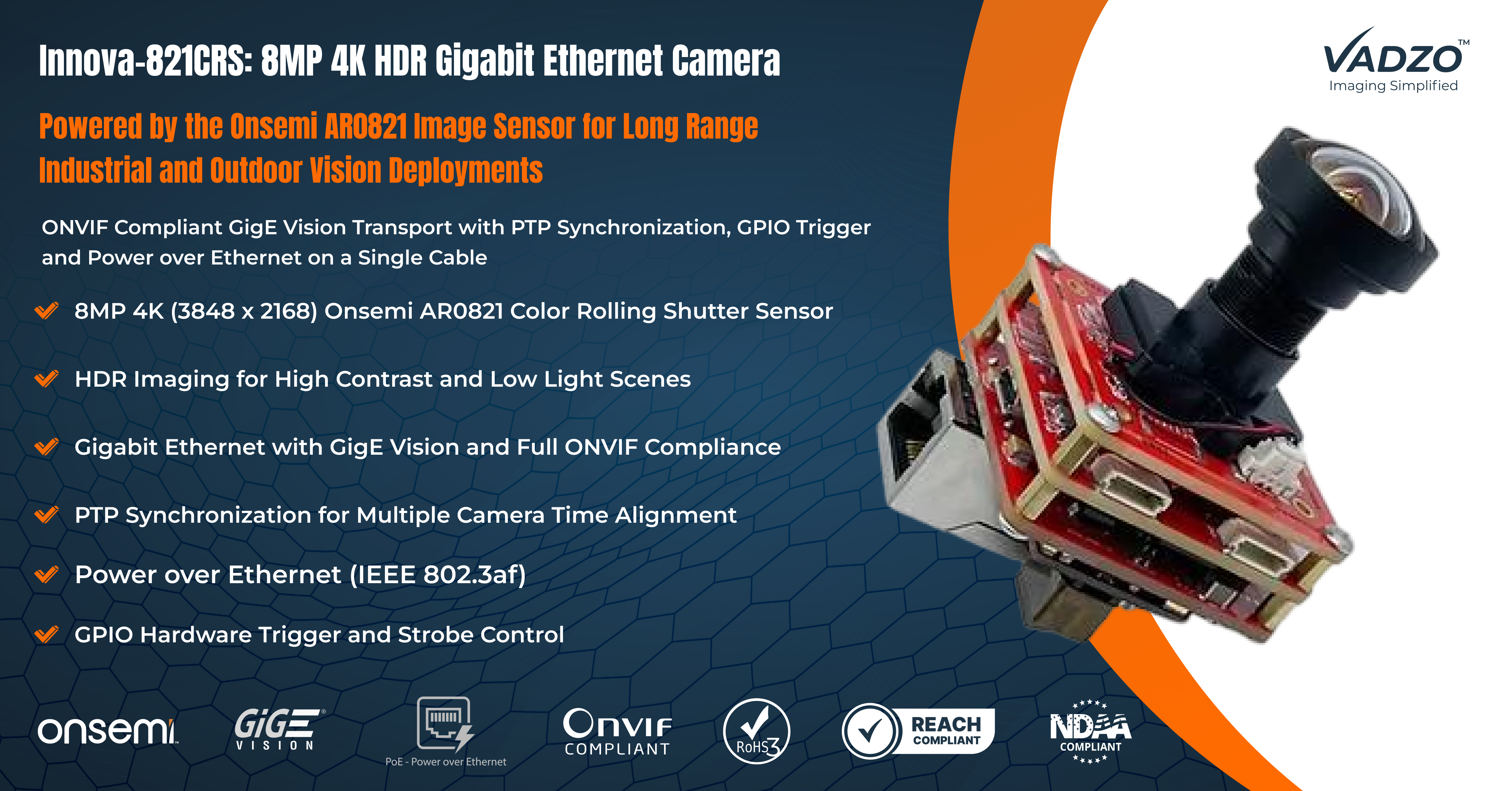
Key Capabilities of the Innova-821CRS Onsemi AR0821 8MP 4K HDR Gigabit Ethernet Camera
Full 8MP 4K Resolution Held Across the Distance Budget: Resolution in a long-range installation is a working range calculation rather than a specification contest. Angular pixel density determines how many pixels land on a target at a given distance, and every detection task carries a threshold below which the analytics layer stops producing reliable output. Plate recognition needs a documented pixel count across the plate, and face capture at a gate needs one between the eyes. A 1080p node that clears those thresholds up close fails them further out. An 8MP 4K GigE Camera answers instead by extending the range at which a single position stays above threshold. This AR0821 GigE Camera holds 3848 x 2168 across the full array rather than reaching 4K by interpolation from a smaller native readout, and the consequence of that 8MP GigE Camera format is fewer poles, fewer network drops, and fewer enclosures for the same coverage. Region of interest cropping gives the AR0821 4K GigE Camera a second mode where a windowed section streams at reduced payload, so one AR0821 4K Camera serves a wide situational view and a narrow high detail zone under software control.
HDR Imaging Across the Contrast Range That Outdoor Scenes Actually Present: High dynamic range is what separates an exterior camera product from an interior one. A high dynamic range camera captures scene content across a luminance span one linear exposure cannot cover, which is the condition at a tunnel mouth, a loading dock door, a tolling lane at night, and a fence line at sunrise. Detection models degrade sharply on clipped input because a saturated region carries no gradient, so an 8MP HDR GigE Camera that keeps both ends of the histogram intact raises inference reliability without any change to the model. As an 8MP 4K HDR GigE Camera, the Innova-821CRS applies that dynamic range at full 4K resolution rather than trading resolution for exposure latitude, and the same capability appears in some catalogs simply as an AR0821 HDR GigE Camera.
Color Output for Descriptive Detection and Incident Review: Color is not decoration in a security or traffic role. It is descriptive data. An operator issuing a lookout works from vehicle and clothing color first, and a classifier separating a delivery van from an emergency vehicle uses chroma alongside shape. A monochrome sensor collects more photons per pixel but discards that information permanently. The Innova-821CRS keeps it, which is why the AR0821 Color GigE Camera configuration is the default for perimeter, roadway, and public space work, while monochrome suits metrology and near-infrared inspection. Depending on which attribute a listing leads with, the same board also appears as an AR0821 HDR Color GigE Camera where dynamic range is the deciding factor, or simply as an 8MP Color Gigabit Ethernet Camera in catalogs organized around interface and resolution alone.
Power over Ethernet and Gigabit Ethernet Delivery on a Single Cable: The Innova-821CRS supports IEEE 802.3af Power over Ethernet, so operating power and image data travel the same cable from a PoE switch or injector. PoE camera architecture eliminates the separate electrical run a conventionally powered node requires, and with it the conduit, the local supply, and a point of failure inside the enclosure. That makes an 8MP PoE Camera deployable on a light pole, a gantry, a warehouse truss or a fence post rather than only where mains power exists. The single cable model also centralizes power management, since a managed switch can cycle an individual AR0821 PoE Camera remotely and turn a site visit into a console command. Specified as an 8MP 4K PoE Camera or as an AR0821 4K PoE Camera, the unit fits the cabling model industrial and municipal installations already standardize on rather than requiring infrastructure of its own.
PTP Synchronization for Multiple Camera Coordination: PTP synchronization turns a set of independent nodes into a coordinated array. The Precision Time Protocol defined in IEEE 1588 distributes a common clock across a network segment and lets devices correct for path delay, so every camera on the segment shares a time base instead of free-running against its own oscillator. For an 8MP GigE Vision Camera in a multiple node deployment, this changes what the analytics layer can do. Timestamps generated at the camera under a shared clock let a downstream system decide whether two detections belong to the same object crossing two fields of view, which is the foundation of vehicle tracking across a corridor, target handoff along a perimeter, and asset association in a yard. Depth estimation, trajectory reconstruction, and speed measurement all assume the frames compared describe the same instant. Moving the time reference into the AR0821 GigE Camera through PTP removes that error at its origin rather than correcting for it in software afterward.
GPIO Hardware Trigger and Strobe Synchronization: GPIO gives the Innova-821CRS a hardware path into the rest of the system. The camera accepts an external trigger so exposure begins at a moment defined by the process rather than by a software command issued from the host. In practice, that signal comes from an inductive loop at an intersection, a radar trigger on a gantry, a photoelectric sensor on a conveyor, or a programmable logic controller. Software-initiated capture cannot match this because the command traverses the network stack and the driver queue before reaching the sensor, and the delay it accumulates is variable. GPIO output drives strobe illumination in phase with exposure, which makes short exposures usable after dark since the light arrives only while the sensor is integrating. For an AR0821 Rolling Shutter GigE Camera, the pairing of a hardware trigger with a phase-locked strobe suppresses motion blur in low light without pushing gain to where noise overwhelms the detail the resolution was chosen to capture.
ONVIF Compliance and GigE Vision Interoperability: The Innova-821CRS is fully ONVIF compliant, so it is discoverable, configurable, and streamable through the same interface video management systems already use. Security infrastructure is rarely built from one vendor, and ONVIF camera security standards exist precisely so a device from one supplier joins a platform from another as a configuration entry rather than a development task. GigE Vision compliance covers the machine vision half, exposing a standardized control and streaming model to inspection software and embedded vision frameworks. An 8MP ONVIF GigE Camera that also speaks GigE Vision can be specified once and deployed into both a security architecture and an automation architecture. Depending on the attribute a tender names first, the same unit is written up as an AR0821 ONVIF GigE Camera or, once resolution is added to the description, an AR0821 ONVIF 4K GigE Camera.
Product Specifications
|
Parameter
|
Specification
|
|
Model
|
Innova-821CRS
|
|
Image Sensor
|
Onsemi AR0821 CMOS
|
|
Sensor Type
|
Color, Rolling Shutter
|
|
Optical Format
|
1/1.7″
|
|
Pixel Size
|
2.1 µm x 2.1 µm DR-Pix Back Side Illuminated
|
|
Resolution
|
8MP 4K 3848(H) x 2168(V)
|
|
Dynamic Range
|
HDR
|
|
Interface
|
Gigabit Ethernet (100Base-T and 1000Base-T) with GigE Vision
|
|
Connector
|
Standard RJ45 Ethernet Interface
|
|
Cable Reach
|
Up to 100 meters
|
|
Power
|
Power over Ethernet, IEEE 802.3af
|
|
Standards Compliance
|
ONVIF Compliant
|
|
Synchronization
|
PTP Synchronization and GPIO Hardware Trigger
|
|
GPIO
|
Hardware Trigger Input and Strobe Output
|
|
Optics
|
S Mount (M12 Standard) with Auto Switch IR-Cut Filter
|
|
Operating System Support
|
Windows, Linux and Android
|
|
SDK
|
Vadzo NXT SDK
|
|
Operating Temperature
|
-30⁰C to +85⁰C
|
|
Dimensions and Weight
|
Three Boards: 38mm (L) x 38mm (B) and 25 Grams of Weight (Without Lens)
|
“Long-range sites are where imaging specifications stop being theoretical. The camera ends up on a pole two hundred meters from the nearest rack, and the scene does whatever the weather and the traffic decide it will do that day. What our customers kept asking for was a 4K node that survives both of those and still drops into infrastructure they already own. That is what the Innova-821CRS is. The AR0821 gives us resolution and dynamic range. Power over Ethernet gives the installer one cable instead of two. PTP synchronization is the part I expect teams to appreciate most, because once four or five nodes watch the same corridor, knowing exactly when each frame was captured becomes the thing the whole analytics layer rests on.” – Alwin Vincent, Product Manager, Vadzo Imaging
Target Applications
Perimeter and Border Security: Perimeter protection is a classification problem stretched across distance. The system has to separate a person from an animal and an intrusion from a branch moving in the wind, at ranges where a lower resolution node does not resolve the features the classifier depends on. A Perimeter Security GigE Camera at 8MP holds enough detail across a long fence segment for that separation to stay reliable. As a Border Security GigE Camera, the Innova-821CRS also handles the illumination profile these sites present, where a floodlit approach road sits inside the same frame as unlit terrain beyond it. Deployed as an AR0821 Rolling Shutter Color Gigabit Ethernet Camera, it feeds a security platform over one PoE run and removes the local power infrastructure remote gate positions otherwise demand.
Traffic Monitoring and Intelligent Transportation: Roadside imaging is the hardest lighting environment in the industry. Headlights enter at full intensity, wet road surfaces reflect unpredictably, and the sun sits close to the optical axis twice a day. A Traffic Monitoring GigE Camera has to hold plate detail against those conditions frame after frame, and HDR for contrast with 4K for range lets one node cover multiple lanes. The AR0821 Rolling Shutter Color GigE Camera configuration suits fixed gantry and pole-mounted enforcement, classification, and incident detection roles where vehicle motion sits inside the exposure envelope. GPIO triggering ties capture to inductive loops and radar while PTP synchronization keeps entry and exit nodes on a common clock, so section speed calculations rest on real capture times. An 8MP Rolling Shutter Color GigE Camera in this role is often tendered under its longer form as an 8MP Rolling Shutter Color Gigabit Ethernet Camera. Where the tender leads with dynamic range rather than shutter type, the same unit is written up as an AR0821 HDR Color Gigabit Ethernet Camera or an 8MP HDR Color Gigabit Ethernet Camera.
Smart City Surveillance Infrastructure: Municipal deployments are defined by scale and by the network that already exists. Imaging nodes go up on light poles, junction boxes, and building facades and connect through the switched infrastructure carrying every other city service, so a Smart City Surveillance GigE Camera has to be a well-behaved network device first. That makes ONVIF compliance and PoE support entry requirements rather than differentiators. An 8MP Color GigE Camera adds the resolution public space monitoring needs across plazas, transit interchanges and intersections. Deployed into smart city solutions, the AR0821 Color Camera provides the detail retrospective incident review depends on, since a recorded 4K stream supports digital zoom into a region a 1080p recording cannot recover.
Industrial Automation and Robotics: Inside a plant, the distance argument holds for different reasons. Overhead gantry positions, crane cabs, furnace observation ports, and outdoor yard positions sit beyond the reach of a board-level interface, and a network drop is the path of least resistance in a facility already wired for Ethernet. A Long Range Industrial GigE Camera supports overview inspection, process monitoring, safety observation, and robotic guidance where the camera cannot be mounted close to the work. Deployed for automation and robotics, the AR0821 4K Rolling Shutter GigE Camera delivers 8MP detail with GPIO synchronization to line control hardware. As an Outdoor Industrial GigE Camera, the same 8MP 4K Rolling Shutter GigE Camera extends that capability to yard cranes, bulk handling, and conveyor transfer points where weather and daylight cycling rule out an indoor specification.
Logistics Yards and Fleet Depot Monitoring: Yard and depot operations depend on knowing which asset is where and when it moved. Gate reads, trailer identification, container marking capture, and dock door occupancy all rely on resolving stenciled characters at distance under whatever light the yard has. A Long Range Industrial Camera at 4K clears that threshold from a mast or building-mounted position without the multiple node arrangements a lower resolution product requires. PTP synchronization matters here too, because a vehicle seen at the gate and again at a dock has to be matched across positions. Integrated into telematics and fleet management platforms, an AR0821 4K Rolling Shutter Gigabit Ethernet Camera ties a telematics event to a verifiable image, and PoE keeps cabling to one run per position across paved areas where trenching is expensive. The 8MP 4K Rolling Shutter Gigabit Ethernet Camera format also leaves headroom for character recognition at oblique angles.
Industrial IoT and Edge AI Deployments: Distributed sensing programs treat the camera as one node among many rather than a standalone system. An Industrial IoT GigE Camera fits that model because it already speaks the protocol the rest of the deployment uses and is managed, updated, and monitored with the same tooling as every other device. An 8MP Gigabit Ethernet Camera feeding an edge AI camera platform gives the inference host high-resolution input without a capture card or a proprietary transport layer in between. Streaming a windowed region alongside a full frame overview lets a single AR0821 Ethernet Camera serve a detection model and an operator view from one position. Teams cataloging by interface alone will see the same board listed simply as an 8MP Ethernet Camera.
Software Support and Integration with the Vadzo NXT SDK
The Innova-821CRS presents a standard GigE Vision interface and full ONVIF compliance, so integration begins with tools most teams already have. Video management systems stream the camera through ONVIF without proprietary drivers, and machine vision frameworks address it through the GigE Vision control model. Host support spans Windows, Linux, and Android platforms, covering both server-class recorders and edge inference hardware such as NVIDIA Jetson camera platforms running perception workloads at the network edge.
For teams that need control beyond standard defaults, the Vadzo NXT SDK provides programmatic access to streaming parameters, region of interest configuration, binning and windowing, exposure and gain control, trigger synchronization, PoE management, and firmware update handling. That depth separates an evaluation unit from a production deployment, because production systems manage device state and roll firmware across a fleet without physical access. Engineers building network-attached perception pipelines can review the integration path in the Vadzo guide to GigE camera integration with Jetson AGX Orin and Isaac ROS, which covers transport and driver considerations that apply to this camera product as well. That same combination of standard interfaces and deep SDK access is what lets an AR0821 4K HDR Gigabit Ethernet Camera move from an evaluation bench to a production fleet without a change in software architecture.
Frequently Asked Questions
Q: What is a GigE camera and when should it be selected over a USB or MIPI CSI-2 camera?
A: A GigE camera transmits image data over standard Gigabit Ethernet using the GigE Vision transport model, so it behaves as a network device rather than as a peripheral attached to a host bus. The selection criteria are physical before they are technical. USB is practical to roughly five meters without active extension, and MIPI CSI-2 is measured in centimeters, so any installation where the camera and host are separated by more than a room points toward Ethernet. A network interface also brings switched topologies, remote configuration, and Power over Ethernet. Vadzo Imaging builds its Gigabit Ethernet camera series around these deployment conditions, and the Innova-821CRS extends that series to 8MP 4K HDR imaging with ONVIF compliance, PTP synchronization, and GPIO triggering so teams moving from a bench prototype to a distributed installation do not have to change vendors to change interfaces.
Q: What does HDR change in an outdoor camera deployment and how much does it matter?
A: Dynamic range describes the luminance span a sensor captures in one frame without clipping the highlights or losing the shadows. Outdoor scenes routinely exceed what a single linear exposure covers, and the consequence is a loss of data downstream processing needs rather than an unattractive image. A clipped highlight contains no gradient, so a detection model has nothing to work with there regardless of how well it was trained. An 8MP Rolling Shutter HDR GigE Camera reconstructs across a wider luminance span so both ends of the histogram survive into the delivered frame. Vadzo covers the underlying engineering in its guide to high dynamic range camera types and how to choose one and supplies the capability across interfaces, so an AR0821 Rolling Shutter HDR GigE Camera and an AR0821 HDR Ethernet Camera describe the same dynamic range behavior reached through different specification routes.
Q: How does PTP synchronization work across a multiple camera network and why is it necessary?
A: The Precision Time Protocol defined in IEEE 1588 establishes a common clock across a network segment. A designated source distributes time, and each device measures and corrects for the delay along its own path, so every node converges on a shared reference rather than free-running against its own oscillator. Once that reference exists, a camera can timestamp a frame at the moment of capture instead of leaving the host to do it on arrival. The distinction matters because arrival time carries the variable latency of the network stack, the driver queue, and the scheduler, and that jitter is not consistent between nodes. Any calculation assuming two frames describe the same instant inherits the error. Section speed measurement, object handoff between fields of view, and trajectory reconstruction all rest on that assumption, which is why PTP synchronization becomes a requirement rather than a convenience as a deployment grows.
Q: What is the difference between ONVIF compliance and GigE Vision compliance?
A: The two standards solve the same interoperability problem for different industries. ONVIF originates in physical security and defines how a network video device is discovered, configured, and streamed so that systems from any vendor work with hardware from any other. GigE Vision originates in machine vision and defines the transport and control model inspection software expects, typically alongside GenICam-style feature access. A device supporting only one of the two is usable in only one ecosystem. Supporting both means the same hardware can be recorded by a security platform and simultaneously addressed by an automation application. Vadzo Imaging designs its ONVIF-compliant 4K GigE camera portfolio to cover both models, which is what allows a site with separate security and automation teams to standardize on one camera product instead of procuring two.
Q: What should engineers evaluate when choosing an 8MP 4K camera for long-range outdoor deployment?
A: Five considerations usually decide the outcome. Working range comes first, calculated from the pixel density a detection task requires at the furthest point in the scene rather than from resolution alone. Dynamic range comes second because outdoor illumination is uncontrolled and a clipped frame is unusable. Transport and power come third, since a node needing a separate electrical run costs more to install than the camera costs to buy. Synchronization comes fourth wherever more than one position observes a shared space. The software ecosystem comes last but decides the schedule. The Vadzo 4K camera portfolio is organized around these decisions, and this AR0821 GigE Camera was specified against all five, pairing an 8MP HDR Gigabit Ethernet Camera format with PoE delivery, PTP synchronization, GPIO triggering, and both ONVIF and GigE Vision support in one unit. Evaluation units are available through the Vadzo online store for teams validating the working range calculation against their own scene first.
Availability and Customization
The Innova-821CRS is available now for evaluation and production orders with no minimum order quantity. Vadzo Imaging supports hardware and firmware customization across its HDR camera portfolio, including lens selection, IP-rated enclosure design, connector and cable assembly changes, illumination integration, firmware modification, and driver porting for additional hosts. Teams evaluating an AR0821 4K Ethernet Camera can request a unit and discuss integration requirements through the Vadzo support and contact page or by contacting the sales team at support@vadzoimaging.com. Technical documentation, the full specification sheet, and ordering details for this 8MP 4K HDR Gigabit Ethernet Camera are published on the product page, and the same AR0821 GigE Camera is backed by direct engineering support for teams moving from evaluation into volume production.
About Vadzo Imaging
Vadzo Imaging is a global provider of embedded vision solutions delivering camera products and imaging platforms for robotics, industrial automation, security and surveillance, smart city infrastructure, medical systems, UAV platforms and edge AI. Its camera products are engineered for integration with leading embedded platforms including NVIDIA Jetson, Raspberry Pi, Qualcomm RB series and NXP i.MX. Beyond hardware, Vadzo provides imaging support spanning sensor integration, ISP tuning, firmware development, and SDK frameworks, giving engineering teams a single partner from evaluation through production. Explore the full Vadzo camera portfolio at www.vadzoimaging.com.
Media Contact
Alwin Vincent
Vadzo Imaging
Email: alwin@vadzoimaging.com
LinkedIn: Vadzo Imaging
YouTube: Vadzo Imaging
X: Vadzo Imaging
SOURCE: Vadzo Imaging
View the original press release on ACCESS Newswire
Media gallery
