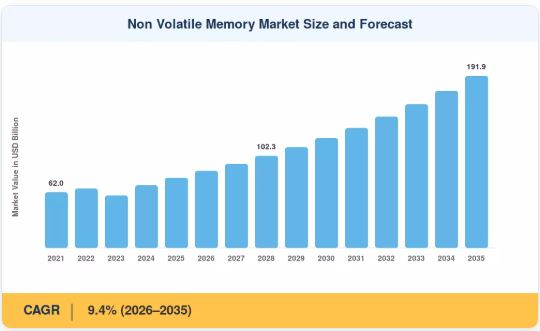
Non Volatile Memory Market Forecast, USD 85.5 Billion in 2026 to USD 191.9 Billion by 2035 at 9.4% CAGR
Non-Volatile Memory Market Size, Share and Research Report By Memory Technology (Flash Memory, Magnetoresistive RAM,
Press Release Disclaimer: This is a press release distributed through the XPR Media network. It has not been independently verified by our newsroom.

Non-Volatile Memory Market Size, Share and Research Report By Memory Technology (Flash Memory, Magnetoresistive RAM, Phase Change Memory, Ferroelectric RAM)
NEW YORK,, NY, UNITED STATES, August 20, 2026 /EINPresswire.com/ — The Global Non-Volatile Memory market reached an estimated USD 78.2 billion in 2025 and is projected to grow from USD 85.5 billion in 2026 to USD 191.9 billion by 2035, registering a CAGR of 9.4% during the forecast period 2026–2035. Two forces anchor this expansion: the global data explosion, with estimates indicating total data creation will reach 181 zettabytes by 2025, and aggressive capital expenditure by leading chipmakers, with Samsung, SK Hynix, and Micron collectively committing over USD 100 billion to memory fab construction through 2028.
Government incentives such as the U.S. CHIPS and Science Act (USD 52.7 billion) and the European Chips Act (EUR 43 billion) are accelerating domestic production capacity and reshaping supply chain geography. The market’s 9.4% CAGR reflects the convergence of AI and ML workload expansion (+2.5% impact), hyperscale data-center capital expenditure (+2.0%), automotive electrification and ADAS (+1.5%), and 3D NAND layer scaling (+1.2%) accelerating across the world’s largest semiconductor-fabrication and hyperscale-cloud economies simultaneously.
The technology landscape within the non-volatile memory market is shifting rapidly. Legacy planar NAND architectures are giving way to 200-plus-layer 3D NAND stacks, while traditional hard disk drives continue to lose enterprise share to solid-state alternatives. Beyond conventional flash, next-generation architectures including magneto resistive RAM, ferroelectric RAM, and phase-change memory are moving from research labs into commercial production, targeting latency-sensitive AI inference and automotive safety applications.
Asia-Pacific commands approximately 42% of global market revenue, driven by fabrication clusters in South Korea, Japan, and China. North America holds roughly a 28% share, buoyed by hyperscale demand and federal semiconductor subsidies. Europe, the third-largest region at about a 20% share, is investing heavily in automotive-grade memory for its electrification transition. The decade ahead will be defined by AI workload scaling, edge computing proliferation, and the strategic localization of chip supply chains.
Get Full PDF Sample Copy of Report: (Including Full TOC, List of Tables & Figures, Chart) @
https://www.marketresearchfuture.com/sample_request/4969
➤ How Significant Is the Non-Volatile Memory Market’s Growth?
The non-volatile memory market’s trajectory from USD 78.2 billion in 2025 to a projected USD 191.9 billion by 2035 represents nearly a two-and-a-half-fold expansion over the forecast decade, reflecting the structural shift from planar NAND and conventional flash toward 200-plus-layer 3D NAND stacks and next-generation architectures including MRAM, FeRAM, and phase-change memory. The market’s 9.4% CAGR is anchored in a data-and-silicon investment super cycle where AI workload scaling, hyperscale capital expenditure, and automotive electrification are all converging to make advanced non-volatile memory foundational infrastructure across cloud, consumer, and automotive computing.
NAND Flash accounts for roughly 58% of market revenue, sustained by cloud storage build-outs and consumer device upgrades, while next-generation memory technologies including MRAM, PCM, and ReRAM are forecast to register the fastest segment CAGR at 18.6% through 2035. NOR Flash maintains stable demand valued at approximately USD 9.4 billion in 2025, driven by automotive MCU boot-code requirements, and EEPROM holds an 8% market share anchored in industrial controls and legacy embedded systems. By application, consumer electronics represents the largest category, contributing roughly 35% of total market share, while enterprise storage is valued at approximately USD 21.9 billion in 2025 as the second-largest vertical, and automotive applications are forecast to register a CAGR of 14.2% through 2035, the fastest among all end-use verticals.
➤ What Does the Future Hold for the Non-Volatile Memory Market?
AI and ML workload expansion contributes approximately +2.5 percentage points to the non-volatile memory market’s CAGR the single highest driver impact. Terabytes of high-bandwidth storage are now needed for each node in large language model training clusters, while edge inference is bringing memory closer to the processor. Each AI server can use 2–4 TB of NAND-based storage for model caching and checkpoint writing, and NVIDIA’s next-generation GPU systems specify up to 192 GB of HBM per accelerator. Forecasts indicate the market will benefit disproportionately as AI workloads increase by an anticipated 40% annually through 2028.
Hyperscaler data-center capital expenditure contributes approximately +2.0 percentage points to the CAGR, establishing cloud infrastructure buildout as a primary structural demand source. Memory and storage accounted for about 18–22% of overall server bill-of-materials expenditures in 2024, when Amazon, Microsoft, and Google combined spent over USD 120 billion on data center infrastructure.
A hyperscaler’s deployment of a new availability zone results in hundreds of petabytes of NVM demand, and since enterprise SSD shipments are expected to surpass 200 exabytes annually by 2027, this spending trend directly favors the market. Automotive electrification and ADAS add a further +1.5% to the CAGR as modern electric vehicles incorporate 64–256 GB of onboard NVM for infotainment, telematics, over-the-air update storage, and ADAS data logging, with the EU’s General Safety Regulation mandating event data recorders in all new vehicles from July 2024 expanding automotive NVM content per vehicle.
The next phase of the market’s evolution centers on AI-centric memory hierarchies, as the rise of large language models restructures traditional CPU-centric architectures toward GPU- and accelerator-centric designs where high-bandwidth memory sits adjacent to the compute die; by 2030, projections indicate 60% of enterprise servers deployed will include dedicated AI accelerators, each requiring two to four times more NVM capacity than conventional servers.
Compute Express Link 3.0, ratified in 2024, enables memory pooling across servers, fundamentally changing how data centers allocate and consume NVM resources by allowing operators to deploy shared memory pools that scale independently rather than provisioning memory per server. Processing-in-memory designs that embed computation directly within memory arrays can reduce data movement energy by up to 90% for AI inference tasks, with Samsung’s HBM-PIM and SK Hynix’s AiM platforms representing early commercial entries that open a new value tier for memory vendors beyond simple bit storage.
Get access to the full description of the report @
https://www.marketresearchfuture.com/reports/non-volatile-memory-market-4969
➤ Who Are the Key Players in the Non-Volatile Memory Market?
The non-volatile memory market is moderately concentrated, with an estimated Herfindahl-Hirschman Index of approximately 2,200, indicating oligopolistic competition. The top five companies Samsung, SK Hynix, Micron, Kioxia, and Western Digital collectively control an estimated 75–80% of global NAND revenue. Competition intensifies at the technology frontier, where layer-count leadership and cost-per-bit efficiency determine market share gains. MRFR identifies the following key participants with estimated revenue share ranges:
★ Samsung Electronics (~28–33% share)
★ SK Hynix (~17–21% share)
★ Micron Technology (~14–18% share)
★ Kioxia (~11–14% share)
★ Western Digital (~9–12% share)
★ Intel / Solidigm (~3–5% share)
★ Infineon Technologies (~2–4% share)
★ STMicroelectronics (~1–3% share)
★ Winbond Electronics (~1–2% share)
★ Renesas Electronics (~1–2% share)
Strategic competition in the non-volatile memory market is increasingly defined by layer-count leadership and cost-per-bit efficiency with cyclical pricing volatility cited as a top structural headwind, as NAND flash ASPs fell by more than 35% in 2023 alone, wiping out billions in vendor revenue and forcing production cuts across all major fabs, alongside the capital intensity of fab construction, with a single advanced memory fab costing USD 15–20 billion to build and equip, U.S. export controls extended in October 2023 that fragment the global supply chain and add an estimated 5–8% to total cost of ownership for global memory procurement, and endurance and retention limits in advanced process nodes.
➤ What Are the Emerging Trends in the Non-Volatile Memory Market?
Several transformational trends are redefining the non-volatile memory market’s evolution through 2035:
AI and ML Workload Expansion: Each AI server can use 2–4 TB of NAND-based storage for model caching and checkpoint writing, and NVIDIA’s next-generation GPU systems specify up to 192 GB of HBM per accelerator, with AI workloads expected to increase by an anticipated 40% annually through 2028.
Hyperscaler Data-Center Capital Expenditure: Amazon, Microsoft, and Google combined spent over USD 120 billion on data center infrastructure in 2024, with memory and storage accounting for 18–22% of server bill-of-materials, as enterprise SSD shipments are expected to surpass 200 exabytes annually by 2027.
3D NAND Layer Scaling: Samsung introduced 236-layer 3D NAND in 2024, and both SK Hynix and Micron have roadmaps extending to 300-plus layers by 2027, with each generation reducing cost-per-bit by 15–20% and expanding the total addressable market into price-sensitive IoT and wearables applications.
CXL and Memory Disaggregation: Compute Express Link 3.0, ratified in 2024, enables memory pooling across servers, improving utilization from a typical 40–50% to 75%-plus and reducing memory-related capital expenditure by 20–30% per rack by allowing operators to deploy shared memory pools independent of individual servers.
Automotive-Grade Memory for Software-Defined Vehicles: As vehicles transition to centralized compute architectures, onboard NVM content could triple from today’s 128 GB average to 384 GB or more by 2030, with European OEMs alone representing a USD 4.5 billion addressable opportunity for automotive-qualified flash by 2030.
Buy Full Research Report:
https://www.marketresearchfuture.com/checkout?currency=one_user-USD&report_id=4969
➤ How Is the Non-Volatile Memory Market Segmented?
The non-volatile memory market report provides a comprehensive segmentation framework:
By Memory Technology: NAND Flash (58% share, 2025), NOR Flash (USD 9.4 billion, 2025), EEPROM (8% share, 2025), Magnetoresistive RAM / MRAM (19.2% CAGR), Ferroelectric RAM / FeRAM (16.8% CAGR), Others — PCM, ReRAM (USD 4.7 billion, 2025)
By Storage Type: Embedded Non-Volatile Memory, Removable Non-Volatile Memory, Non-Volatile Memory Modules
By Application: Consumer Electronics (35% share, 2025), Enterprise Storage (11.5% CAGR), Automotive (14.2% CAGR), Industrial (USD 9.4 billion, 2025), Healthcare (5% share, 2025)
By End Use: Personal Use, Commercial Use, Enterprise Use
By Region: Asia-Pacific (42% share, 2025), North America (10.1% CAGR), Europe (USD 15.6 billion, 2025), South America (11.3% CAGR), Middle East & Africa (USD 3.9 billion, 2025)
➤ What Are the Regional Insights from the Non-Volatile Memory Market?
Asia-Pacific leads the non-volatile memory market because it houses the world’s largest memory fabrication facilities and the densest consumer electronics manufacturing base, commanding a 42% share in 2025. South Korea holds 38% of regional share as Samsung and SK Hynix together account for over 60% of global NAND output. China is posting a 10.8% CAGR within the region as YMTC continues to scale 232-layer NAND production despite export-control headwinds, targeting domestic smartphone and server markets.
Japan contributed USD 5.1 billion through the Kioxia/Western Digital joint venture, which operates some of the world’s most advanced 3D NAND fabs in Yokkaichi and Kitakami, Taiwan holds 12% of regional share through TSMC’s embedded memory and packaging innovation, and India is growing at a 14.5% CAGR through data-center buildout and its semiconductor mission.
North America holds roughly a 28% share of the global non-volatile memory market, driven by both demand-side pull from AI training clusters consuming petabytes of storage and supply-side push from new domestic manufacturing capacity. The United States commands 82% of regional share as its concentration of hyperscale data-center operators drives demand, with the CHIPS Act having catalyzed over USD 200 billion in announced semiconductor investments, including Micron’s USD 100 billion New York fab complex. Canada is growing at an 8.9% CAGR through AI research clusters and cloud adoption, and Mexico contributed USD 0.7 billion through electronics assembly and nearshoring.
Europe’s non-volatile memory market, valued at USD 15.6 billion in 2025, is distinctively shaped by its automotive industry, the region’s third-largest share at about 20% of global revenue. Germany commands 28% of regional share as German OEMs Volkswagen, BMW, and Mercedes are among the largest consumers of automotive-grade NOR and NAND flash globally.
France is posting a 9.7% CAGR through STMicroelectronics’ expansion and defense electronics applications, the United Kingdom contributed USD 2.1 billion through cloud computing and fintech data infrastructure, and the Netherlands holds 11% of regional share through the ASML ecosystem and semiconductor R&D, with the European Chips Act having mobilized EUR 43 billion to double the continent’s share of global semiconductor production to 20% by 2030.
South America and the Middle East & Africa round out the non-volatile memory market’s regional footprint, with South America posting an 11.3% CAGR through 2035. Brazil commands 62% of South American revenue as its data-localization law, the LGPD, and expanding hyperscale presence including AWS São Paulo and Azure Brazil South regions push local storage infrastructure investment, with smartphone penetration exceeding 85% across major urban centers, while Colombia is growing at a 12.1% CAGR through digital transformation and telecom modernization.
In the Middle East & Africa, valued at USD 3.9 billion in 2025, the UAE commands 35% of regional share through smart-city projects and NEOM-adjacent data infrastructure, Saudi Arabia is growing at a 12.8% CAGR through Vision 2030 and sovereign cloud mandates that specify modern NVM architectures from inception rather than retrofitting, creating disproportionate adoption rates for high-density enterprise SSDs, and South Africa contributed USD 0.5 billion through telecom backbone upgrades.
➤➤➤ Regional & Country-Level Reports by Market Research Future:
US Non-Volatile Memory Market –
https://www.marketresearchfuture.com/reports/us-non-volatile-memory-market-16763
➤➤➤ Industry Analysis Reports by Market Research Future:
Equipment Monitoring Market
https://www.marketresearchfuture.com/reports/equipment-monitoring-market-7477
Fiber Management Systems Market
https://www.marketresearchfuture.com/reports/fiber-management-systems-market-11929
Push Rod Sensor Market
https://www.marketresearchfuture.com/reports/push-rod-sensor-market-12407
Smartwatch Battery Market
https://www.marketresearchfuture.com/reports/smartwatch-battery-market-12503
Energy Storage System Battery Management System Market
https://www.marketresearchfuture.com/reports/energy-storage-system-ess-battery-management-system-bms-market-12571
Fully Automatic Molding Machine Market
https://www.marketresearchfuture.com/reports/fully-automatic-molding-machine-market-13904
Japan High Precision Gnss Module Market
https://www.marketresearchfuture.com/reports/japan-high-precision-gnss-module-market-16083
Industrial Thermopile Sensors Market
https://www.marketresearchfuture.com/reports/industrial-thermopile-sensors-market-17187
Handheld Marine Radio Market
https://www.marketresearchfuture.com/reports/handheld-marine-radio-market-16106
Hyper Automation Market
https://www.marketresearchfuture.com/reports/hyper-automation-market-19259
Sagar Kadam
Market Research Future
+ +1 628-258-0071
email us here
Legal Disclaimer:
EIN Presswire provides this news content “as is” without warranty of any kind. We do not accept any responsibility or liability
for the accuracy, content, images, videos, licenses, completeness, legality, or reliability of the information contained in this
article. If you have any complaints or copyright issues related to this article, kindly contact the author above.

Media gallery