Vadzo Imaging Validates Quad Shutter Control on Bolt-900MGS 3MP Sony IMX900 Global Shutter MIPI Camera
The Bolt-900MGS brings Sony's Pregius S IMX900 sensor, Quad HDR, NIR-enhanced sensitivity, and Quad Shutter Control
Press Release Disclaimer: This is a press release distributed through the XPR Media network. It has not been independently verified by our newsroom.

The Bolt-900MGS brings Sony’s Pregius S IMX900 sensor, Quad HDR, NIR-enhanced sensitivity, and Quad Shutter Control together in a 3MP global shutter camera with MIPI CSI-2 connectivity. Its combination of high-speed motion capture and extended dynamic-range and near-infrared imaging capabilities supports machine vision, robotics, surveillance, and automotive systems operating across challenging lighting conditions.
FORT WORTH, TX / ACCESS Newswire / September 16, 2026 / Vadzo Imaging today announced the validation of Quad Shutter Control on the Bolt-900MGS, a 3MP IMX900 camera featuring Sony’s Pregius S IMX900 global shutter sensor and MIPI CSI-2 connectivity. As a global shutter MIPI camera, the Bolt-900MGS combines high-speed motion capture with Quad HDR and NIR-enhanced sensitivity for machine vision, robotics, surveillance, and automotive applications. The global shutter camera is designed for imaging systems that need reliable image capture across high-contrast, low-light, and near-infrared conditions, while Quad Shutter Control provides additional flexibility in managing exposure for demanding imaging environments.
Why Demanding Vision Applications Need an IMX900 Global Shutter MIPI Camera Built for NIR, HDR, and Shutter Flexibility Together
Extreme dynamic range handling and genuine motion accuracy solve one category of problem, but neither capability on its own extends a sensor’s usable range into low-light or no-light conditions specifically, and many real machine vision, robotics, and automotive deployments encounter exactly this additional challenge on a routine basis. An NIR Global Shutter MIPI Camera needs to resolve detail using near-infrared light even when almost no visible light remains, while still holding the same dynamic range and motion accuracy that a well-lit scene depends on.
A Sony IMX900 GS MIPI Camera approaches half of that dynamic range challenge by combining four separate exposure levels within a single frame readout, extending usable range well past what a standard exposure technique can achieve while global shutter capture holds geometric accuracy through genuine motion. A Multi Exposure MIPI Global Shutter configuration like this one gives integrators that combination from a single sensor rather than requiring separate hardware for dynamic range and motion accuracy, respectively.
A separate, related consideration is how a camera is actually triggered and controlled once it is deployed, since a machine vision station, a robotics work cell, and an automotive platform often need genuinely different capture timing, whether that means continuous free-running capture, a precisely triggered single frame, or synchronization with another camera or an external event. An IMX900 3MP Global Shutter MIPI Camera limited to one fixed triggering mode constrains integration options in exactly the deployments where flexible control matters most.
Engineering Explanation: Three Native Capabilities on One Sensor
Sony engineered the Pregius S IMX900 with genuine Quad HDR, NIR sensitivity, and shutter control flexibility as native sensor capabilities, rather than treating any of the three as a partial addition layered onto a design optimized around only one specification. As a Quad HDR Global Shutter Sensor, the Bolt-900MGS resolves detail across extreme dynamic range and low light conditions from the same underlying hardware, without forcing an integrator to choose which capability matters most for a given deployment.
That combination holds up specifically because NIR sensitivity does not come at the expense of the sensor’s dynamic range handling, and Quad HDR does not come at the expense of near-infrared response. As a Global Shutter NIR MIPI Module, the Bolt-900MGS delivers full performance in each capability simultaneously, functioning as a genuine NIR Quad HDR Sensor rather than a specification sheet listing three features that were never validated together.
Quad Shutter Control extends that flexibility to how a frame is actually captured and triggered. As a Quad Mode MIPI Sensor, the Bolt-900MGS switches between distinct shutter and trigger configurations depending on what a specific application requires, whether that means continuous capture, an externally triggered single frame, or precise synchronization with another camera or event.
A 3MP NIR MIPI Camera delivers all of this at a resolution suited to demanding machine vision, robotics, surveillance, and automotive tasks, giving integrators detail sufficient for identification and measurement tasks without the bandwidth overhead a much higher resolution stream would introduce across a MIPI-connected embedded platform.
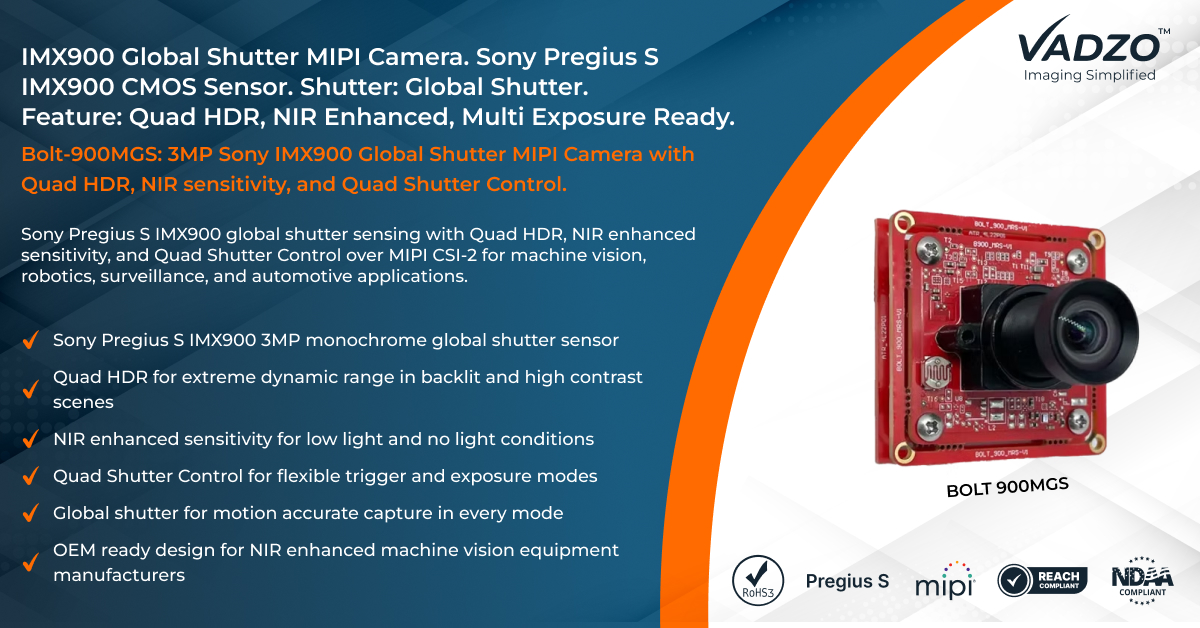
Product Overview
The Bolt-900MGS pairs the IMX900 Monochrome MIPI Camera sensor with Quad HDR, NIR-enhanced sensitivity, and Quad Shutter Control in a compact design suited to machine vision, robotics, surveillance, and automotive integration. As a 3MP GS MIPI Sensor Module, it outputs full 3-megapixel resolution with all three capabilities active by default, giving integrators a single camera platform that covers extreme backlighting, low-light and no-light conditions, and varied triggering requirements from one module.
At the core of the module sits the Sony Pregius IMX900 MIPI Camera sensor, chosen specifically for the combination of dynamic range, near infrared sensitivity, and control flexibility that demanding embedded applications require. Because the camera pairs IMX900 GS MIPI Camera Module connectivity with all three native capabilities, the Bolt-900MGS reaches usable image quality across lighting and triggering conditions that would defeat a camera built around only one or two of these specifications, all delivered as a 3MP Quad Mode Camera suited to compact embedded designs.
Product Specifications
Key specs: 3MP (2064 × 1552) Max Resolution | Sony Pregius S IMX900, 1/3.1-inch Sensor Format | 2.25 µm BSI Pixel | Monochrome, Global Shutter with Quad HDR (120 dB) and NIR Enhanced Response Chroma and Shutter | MIPI CSI-2 Interface | S-Mount (M12) Optics
Key Capabilities
Sony Pregius S IMX900 Sensor for Detailed 3MP NIR Enhanced Capture: The Bolt-900MGS is built around the Sony Pregius S IMX900 sensor, a device that resolves genuine 3 megapixel detail across extreme dynamic range and low light conditions for machine vision, robotics, surveillance, and automotive applications. This gives the module 3MP NIR GS Sensor performance suited to tasks that need to identify a subject clearly, regardless of the lighting extremes or the amount of visible light a specific moment presents. That reliability matters directly for automated decision-making, where a missed detail due to extreme lighting or insufficient visible light could translate into a missed defect, an inaccurate robotic reference point, or an unresolved surveillance event.
NIR Enhanced Sensitivity for Low Light and No Light Conditions: A machine vision station, a robotics work cell, or an automotive cabin can encounter conditions where almost no visible light remains, and a sensor without genuine near-infrared sensitivity produces an unusable frame regardless of how well it otherwise handles dynamic range or motion. The Bolt-900MGS extends genuine sensitivity into the near infrared range, resolving detail that would otherwise be lost the moment visible light disappears. That extended sensitivity matters most for exactly the deployments that cannot control their own lighting conditions, such as an outdoor robotics platform or a vehicle cabin that experiences both bright daylight and complete darkness within the same operating day.
Quad HDR for Extreme Dynamic Range Alongside NIR Sensitivity: Extreme dynamic range and near-infrared sensitivity solve two different problems that a single deployment can still encounter simultaneously, such as a backlit scene at dusk where both extreme contrast and fading visible light are present at once. As a Quad Exposure Vision Module, the Bolt-900MGS holds both capabilities together, resolving detail across extreme highlight and shadow contrast while extending into the near infrared range as visible light fades.
Quad Shutter Control for Flexible Trigger and Exposure Modes: Different deployments need genuinely different capture timing, and a sensor limited to one fixed triggering behavior constrains integration in exactly the deployments where flexible control matters most. As a Quad Mode Vision Sensor, the Bolt-900MGS switches between distinct shutter and trigger configurations to match a specific application’s timing requirement, and as a Plug and Play GS NIR device, it applies that same flexibility without requiring custom firmware development for each new triggering scenario.
Global Shutter for Motion Accurate Capture in Every Mode: Robotics platforms and automotive applications frequently involve genuine motion during capture, and that motion does not pause simply because a scene also happens to be extremely backlit or dimly lit. The Bolt-900MGS’s global shutter exposes the entire frame simultaneously regardless of which specific HDR exposure, NIR condition, or shutter control mode is active, holding geometric accuracy through motion that a rolling shutter sensor could not maintain under the same combined conditions. That distortion-free capture matters directly for automated measurement and navigation tasks, where an inaccurate geometric reading due to shutter skew could propagate into a genuinely incorrect robotic action or automotive decision.
OEM Ready Design for NIR Enhanced Machine Vision Equipment Manufacturers: NIR-enhanced machine vision equipment manufacturers producing units at scale need a camera platform that stays consistent across a long production run, from early prototype validation through full-scale manufacturing. Vadzo Imaging supports full customization on this platform as a Multi-Exposure MIPI Sensor Kit, including connector changes, housing design, and firmware adjustments for manufacturers headed into volume production, and as an OEM GS NIR MIPI Module, it gives OEM customers a proven foundation to build a differentiated machine vision, robotics, surveillance, or automotive product around. As a MIPI CSI-2 GS NIR Kit, it fits directly into a manufacturer’s existing platform architecture.
“Integrators across machine vision, robotics, surveillance, and automotive keep telling us the same thing: a real deployment rarely presents just one challenge at a time; it presents extreme lighting contrast, fading visible light, and a specific triggering requirement all together. The IMX900’s combination of Quad HDR, genuine NIR sensitivity, and Quad Shutter Control gives the Bolt-900MGS a real answer to all three at once, validated together rather than as three separate specification sheet claims. We built this camera for the combined conditions a real deployment presents, not a single controlled demonstration.” – Alwin Vincent, Product Manager at Vadzo Imaging.
Application-Specific Sections
Machine Vision and Inspection in Variable and Low Light: Machine vision and inspection tasks routinely examine parts under uneven or fading lighting, where a reflective surface catches direct light while an adjacent area sits in near darkness. As a NIR Machine Vision MIPI Camera, the Bolt-900MGS’s combined capabilities support that challenging lighting, and functioning as a GS NIR Inspection Camera, it extends the same reliability to broader inspection systems operating across a full lighting range.
Robotics with Combined HDR and NIR Requirements: Robotics platforms operating near windows, under mixed lighting, or into low-light areas of a facility encounter exactly the combined extreme contrast and fading visible-light challenge the Bolt-900MGS is built to address. As a Multi Exposure Robotics MIPI platform, the Bolt-900MGS supports that combination directly, giving robotics integrators dependable detail regardless of a work cell’s specific lighting or a robotic arm’s current motion.
Surveillance Beyond Visible Light Range: Surveillance positions need to remain useful well past the point where visible light disappears, while still holding dynamic range performance for the hours visible light remains. As an NIR GS Surveillance Sensor, the Bolt-900MGS supports that continuous coverage, giving security teams dependable detail through both extreme daytime lighting contrast and fully dark overnight conditions.
Automotive and In-Cabin Vision with NIR Sensitivity: Automotive and in-cabin vision systems combine a bright windshield or window with a dim interior during the day and near-total darkness at night, presenting both the extreme contrast and low-light challenge the Bolt-900MGS addresses together. As a GS NIR Automotive Sensor, the Bolt-900MGS supports both daytime and nighttime in cabin- and exterior-facing reliability, and as an NIR Enhanced GS Camera, it gives automotive integrators a single sensor platform for both driver monitoring and exterior-facing vision tasks.
OEM Integration for NIR Enhanced GS Equipment Manufacturers: NIR enhanced equipment manufacturers building their own machine vision, robotics, surveillance, or automotive hardware need a camera vendor who understands the combined dynamic range, sensitivity, and control requirements those systems demand together. The Bolt-900MGS ships from a GS NIR Camera Supplier with those requirements built in, and Vadzo Imaging supports OEM customization for cable length, connector type, and firmware for manufacturers standardizing on one camera across multiple NIR-enhanced product lines. As an NIR GS Camera Manufacturer, Vadzo Imaging serves OEM programs of any scale.
Frequently Asked Questions
Q: What does NIR sensitivity add to a camera that already has Quad HDR and global shutter capability?
A: Quad HDR and global shutter together solve the problem of capturing an extreme dynamic range scene accurately during genuine motion, but neither capability on its own extends a sensor’s usable range into low-light or no-light conditions specifically. NIR, or near infrared, sensitivity addresses a separate problem entirely, extending a sensor’s ability to resolve detail using near infrared light, which remains present even when almost no visible light does, provided a near infrared illuminator or the near infrared component of ambient light is available. The Bolt-900MGS combines all three capabilities together specifically because many real machine vision, robotics, and automotive applications encounter extreme lighting contrast, genuine motion, and low or no visible light, sometimes within the same deployment, and a sensor built around only one or two of these three capabilities would leave a genuine gap in coverage.
Q: What is Quad Shutter Control, and how does it differ from Quad HDR?
A: Quad HDR refers specifically to the sensor’s ability to combine four separate exposure levels within a single frame readout to extend dynamic range, while Quad Shutter Control refers to a separate capability, the sensor’s ability to switch between four distinct shutter and trigger configurations depending on how a specific application needs to capture a frame, whether that means a continuously free running capture mode, an externally triggered single frame capture, or a mode synchronized precisely with an external event or another camera. These two capabilities work independently of each other, since a sensor could theoretically offer one without the other, and the Bolt-900MGS specifically combines both because many machine vision, robotics, and automotive integrations need both extreme dynamic range handling and flexible control over exactly when and how a frame is captured.
Q: Can this camera really combine NIR sensitivity, Quad HDR, and flexible shutter control without compromising any single capability?
A: Yes, provided each capability is genuinely built into the sensor’s core architecture rather than layered on as a partial or compromised addition to a design originally optimized around only one of these three specifications. The underlying sensor was engineered with all three capabilities as native features rather than treating any of them as an afterthought, which is what allows the Bolt-900MGS to deliver full Quad HDR dynamic range, genuine NIR sensitivity, and complete shutter control flexibility simultaneously rather than forcing an integrator to choose which one matters most for a given deployment. Integrators evaluating a camera claiming this combination of capabilities should request validation data demonstrating each capability under realistic conditions rather than assuming a specification sheet listing all three guarantees uncompromised performance in every one of them.
Q: Can Vadzo Imaging customize an NIR-enhanced global shutter MIPI camera module for a specific machine vision or robotics platform?
A: Yes. Vadzo Imaging supports full OEM customization on the Bolt-900MGS, including optics selection suited to a specific mounting position or field of view, connector and cable configuration matched to a particular embedded platform design, and firmware adjustments tuned for a specific combination of Quad HDR exposure profile, NIR sensitivity balance, and shutter control mode. Evaluation units ship with no minimum order requirement, and the same engineering team that built the standard product works directly with equipment manufacturers to adapt the module for a specific machine vision, robotics, surveillance, or automotive platform headed into volume production.
Q: What should equipment manufacturers look for when choosing an NIR-enhanced Quad HDR global shutter camera supplier?
A: A camera that demonstrates Quad HDR, NIR sensitivity, and flexible shutter control separately in three different demonstrations does not necessarily deliver all three together under the specific combined conditions a real deployment will actually present. Manufacturers should look for validation data demonstrating these capabilities in combination, such as genuine dynamic range performance under low visible light with NIR illumination active, rather than three isolated demonstrations, along with a supplier able to support firmware customization for a specific combination of these features. The Bolt-900MGS is built around exactly these priorities, since a genuinely capable multi-feature sensor depends on real combined performance, not three separate specification sheet claims that were never actually validated together.
Availability
The Bolt-900MGS IMX900 Global Shutter MIPI Camera is available now and ready for evaluation and OEM integration. Evaluation kits include the camera module, an S-Mount lens, an MIPI CSI-2 interface cable, and integration documentation covering Quad HDR, NIR, and shutter control configuration, with no minimum order requirement. Contact Vadzo Imaging at support@vadzoimaging.com to request an evaluation unit or discuss volume production and OEM customization. Evaluation feedback is also welcome directly through the same contact channel, since real combined deployment conditions across machine vision, robotics, surveillance, and automotive applications often surface details a bench test alone would not reveal, and that feedback helps confirm a configuration before a manufacturer commits to a full production order across an entire product line.
About Vadzo Imaging
Vadzo Imaging develops embedded and machine vision camera products for OEMs, system integrators, and NIR-enhanced equipment manufacturers building production-ready vision systems across machine vision, robotics, security, automotive, and edge AI applications. The company’s portfolio spans MIPI CSI-2, USB, GigE, Wi-Fi, FPD-Link III, and SerDes interface camera products, supporting deployment architectures from compact onboard modules to distributed networked installations. Vadzo provides end-to-end imaging support including sensor integration, ISP tuning, firmware development, and SDK frameworks to accelerate system deployment, and the company’s engineering team works directly with customers throughout evaluation, pilot deployment, and volume production rather than handing off support after the initial sale. That ongoing engineering relationship matters most for multi-capability programs, where a camera platform may remain part of a validated embedded design for years after initial deployment across multiple product verticals. Visit Vadzo Imaging to explore the full embedded vision camera portfolio.
Media Contact
Alwin Vincent
Vadzo Imaging
Email: alwin@vadzoimaging.com
LinkedIn: Vadzo Imaging
YouTube: Vadzo Imaging
X: Vadzo Imaging
SOURCE: Vadzo Imaging
View the original press release on ACCESS Newswire
Media gallery