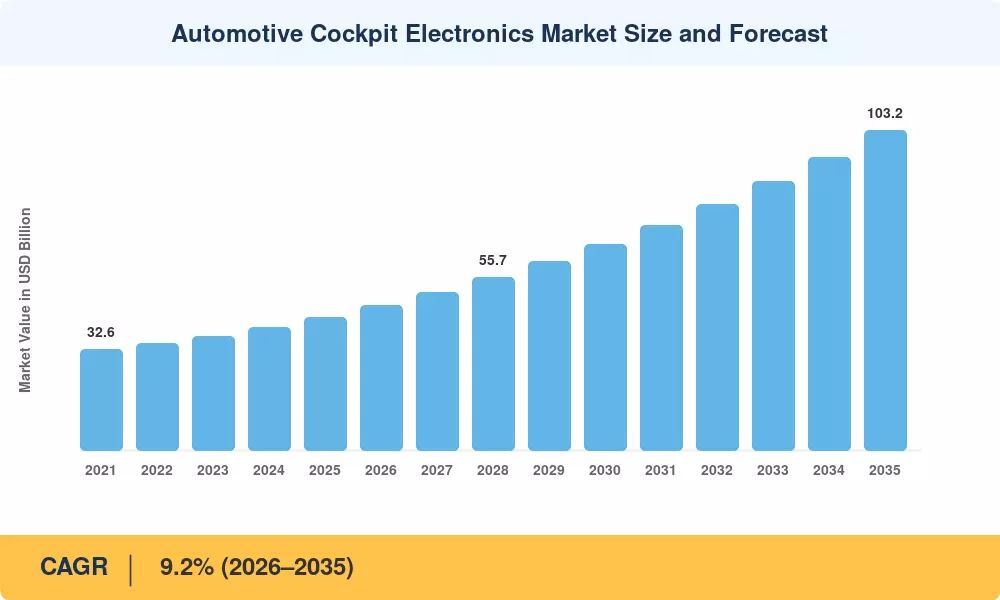
Automotive Cockpit Electronics Market to Reach USD 103.2 Billion by 2035, Growing at 9.2% CAGR
Passenger cars generate over 82% of total Automotive Cockpit Electronics Market revenue, given the volume and
Press Release Disclaimer: This is a press release distributed through the XPR Media network. It has not been independently verified by our newsroom.

Passenger cars generate over 82% of total Automotive Cockpit Electronics Market revenue, given the volume and feature-intensity of the segment.
NEW YORK, NY, UNITED STATES, August 26, 2026 /EINPresswire.com/ — According to Market Research Future, the Automotive Cockpit Electronics Market is projected to grow from USD 46.7 billion in 2026 to USD 103.2 billion by 2035, registering a CAGR of 9.2% during the forecast period 2026 to 2035, driven by the integration of advanced driver assistance systems. This remarkable growth trajectory underscores the rapid technological transformation occurring within the automotive sector, where the traditional vehicle dashboard is evolving into a sophisticated, software-defined digital command center that enhances safety, connectivity, and the overall driving experience.
Market Overview
Automotive cockpit electronics encompass the integrated hardware and software systems that manage vehicle information, entertainment, navigation, and control functions. This includes digital instrument clusters, infotainment systems, head-up displays, telematics units, and central control modules that collectively form the vehicle’s digital cockpit. The market is witnessing unprecedented expansion as automakers shift from analog gauges and isolated electronic components to fully integrated, connected cockpit solutions that leverage high-performance computing platforms and advanced display technologies.
The key growth drivers propelling this market expansion include the increasing integration of advanced driver assistance systems, which demand sophisticated display and processing capabilities. The rapid adoption of electric and hybrid vehicles is another significant factor, as these vehicles require advanced digital interfaces for battery management, range estimation, and charging station integration. Rising consumer expectations for seamless connectivity, over-the-air updates, and personalized in-car experiences are compelling manufacturers to invest heavily in next-generation cockpit electronics.
Technological developments are reshaping the landscape at an accelerating pace. The migration from analog to digital instrument clusters, the emergence of pillar-to-pillar displays, and the integration of augmented reality in head-up displays are revolutionizing how drivers interact with their vehicles. Artificial intelligence and machine learning algorithms are being embedded into cockpit systems to enable voice recognition, gesture control, and predictive personalization features. Additionally, the convergence of 5G connectivity and edge computing is enabling real-time data processing and enhanced infotainment capabilities.
Policy and regulatory frameworks are playing a crucial role in shaping market dynamics. Government mandates regarding vehicle safety, emissions monitoring, and driver assistance systems are accelerating the adoption of advanced cockpit electronics. Regulatory bodies worldwide are implementing stringent safety standards that require real-time monitoring and display of critical vehicle parameters, further driving the demand for sophisticated digital cockpit solutions. Moreover, data privacy and cybersecurity regulations are influencing the design and architecture of connected cockpit systems.
The demand outlook for automotive cockpit electronics remains exceptionally strong, driven by the increasing digitalization of vehicles and the growing consumer preference for technology-rich driving environments. As vehicles become more autonomous and connected, the cockpit is evolving into a central hub for entertainment, communication, and productivity, creating sustained demand across all vehicle segments.
📍 Get Free Sample Report for Detailed Market Insights:
https://www.marketresearchfuture.com/sample_request/5200
Market Segmentation
The automotive cockpit electronics market is segmented based on product type, vehicle type, and regional analysis to provide a comprehensive understanding of the industry landscape.
By Product: The market is categorized into Head-Up Display, Information Display, Infotainment and Navigation, Instrument Cluster, Telematics, and Other Products. Head-up displays are gaining significant traction as they project critical driving information onto the windshield, allowing drivers to maintain focus on the road. Information displays, including center stack screens and rear-seat entertainment systems, are witnessing growing demand as consumers seek larger, higher-resolution displays with intuitive interfaces. Infotainment and navigation systems remain the cornerstone of the cockpit experience, integrating entertainment, connectivity, and routing functionalities into seamless user experiences. The Automotive Head-Up Display Market is experiencing rapid growth as augmented reality HUDs emerge as a key differentiator in premium vehicle segments. Instrument clusters are transitioning from analog gauges to fully customizable digital displays that offer enhanced driver information and personalization options. Telematics systems are becoming increasingly sophisticated, enabling vehicle tracking, remote diagnostics, emergency services, and usage-based insurance applications, while other products such as control modules and sensors round out the ecosystem.
By Vehicle Type: The market is divided into Passenger Cars and Commercial Vehicles. Passenger cars constitute the largest segment, driven by high production volumes and consumer demand for premium in-car experiences. Luxury and mid-range passenger vehicles are increasingly equipped with advanced cockpit electronics as standard features, while economy models are gradually incorporating these technologies to remain competitive. Commercial vehicles, including trucks, buses, and fleet vehicles, represent a growing segment as telematics and fleet management solutions become essential for operational efficiency, driver safety, and regulatory compliance.
By Region: The market analysis covers North America, Europe, South America, Asia Pacific, and the Middle East and Africa. Asia Pacific dominates the global market, driven by massive automotive production in China, Japan, South Korea, and India, coupled with rapid technological adoption and increasing consumer disposable income. North America and Europe follow closely, supported by early technology adoption, strong automotive R&D investments, and stringent safety regulations.
🛒 You can buy this market report at:
https://www.marketresearchfuture.com/checkout?currency=one_user-USD&report_id=5200
Regional Analysis
North America remains a prominent market for automotive cockpit electronics, driven by strong consumer demand for advanced technology features and the presence of leading automotive manufacturers and technology companies. The United States accounts for the majority share, with consumers showing strong preference for large displays, premium audio systems, and advanced connectivity features. The region’s robust regulatory framework regarding vehicle safety and emissions is accelerating the adoption of advanced driver assistance systems, subsequently driving demand for sophisticated cockpit electronics. Canadian and Mexican markets are also witnessing steady growth, supported by increasing automotive production and rising technology adoption.
Europe represents a mature and technologically advanced market, characterized by early adoption of digital cockpit technologies and strong emphasis on automotive safety and innovation. Germany, as the automotive powerhouse, leads the regional market with prestigious brands investing heavily in next-generation cockpit experiences. The European Union’s stringent safety regulations and commitment to reducing road fatalities are driving integration of advanced driver assistance systems and smart display technologies. The region is also at the forefront of developing software-defined vehicles, with major manufacturers transitioning to centralized computing architectures for more efficient cockpit management.
Asia Pacific emerges as the fastest-growing and largest regional market, fueled by massive automotive manufacturing capabilities, rapid urbanization, and expanding middle-class population. China dominates the regional landscape with the world’s largest automotive market and aggressive government initiatives promoting electric vehicles and intelligent connected vehicles. Japanese and Korean manufacturers continue to push technological boundaries, introducing innovative cockpit solutions with advanced human-machine interfaces. India, Southeast Asian nations, and Australia are witnessing significant market growth as consumer awareness and disposable incomes increase, driving demand for enhanced in-vehicle experiences.
South America and the Middle East and Africa represent emerging markets with substantial growth potential. South American markets like Brazil and Argentina are gradually adopting advanced cockpit technologies as automotive production and consumer demand for modern vehicles increase. The Middle East, particularly the Gulf Cooperation Council countries, shows strong demand for luxury and premium vehicles equipped with state-of-the-art cockpit electronics. African markets are at a nascent stage but hold promise as automotive infrastructure develops and vehicle penetration rates increase.
Competitive Landscape and Key Players
The automotive cockpit electronics market is highly competitive, with a mix of established automotive suppliers, technology giants, and emerging innovators vying for market share. Leading players are focusing on strategic partnerships, technological innovation, and portfolio expansion to strengthen their market position.
Key companies operating in this space include Continental AG, Bosch, Denso Corporation, Visteon Corporation, Harman International, Aptiv PLC, Panasonic Corporation, Samsung Electronics, LG Electronics, and NXP Semiconductors. These industry leaders are investing heavily in research and development to create integrated, scalable cockpit platforms that support multiple displays, advanced processing capabilities, and seamless connectivity.
Strategic developments are reshaping the competitive landscape. Major suppliers are forming collaborations with semiconductor companies to develop powerful system-on-chip solutions capable of handling complex cockpit functions. Partnerships between automotive suppliers and technology giants like Google, Amazon, and Microsoft are enabling enhanced connectivity, cloud-based services, and voice assistant integration. Acquisitions and mergers are consolidating expertise in software, artificial intelligence, and user experience design. The evolution of the Human Machine Interface Market is playing a pivotal role in this transformation, as intuitive and responsive interfaces become essential for delivering seamless driver-vehicle interactions and enhancing overall user satisfaction.
Innovation and technology initiatives are accelerating across the industry. Companies are developing centralized domain controllers that consolidate multiple electronic control units, reducing complexity and cost while improving system performance. The integration of artificial intelligence for predictive personalization and natural language processing is becoming a key differentiator. Augmented reality head-up displays, 3D instrument clusters, and curved OLED screens represent the latest innovations in display technology, offering drivers more immersive and intuitive interfaces.
Latest Industry News and Developments
Recent industry developments highlight the dynamic nature of the automotive cockpit electronics market. A leading global supplier recently announced the launch of a new cockpit domain controller that integrates multiple functions into a single, high-performance computing platform, enabling automakers to reduce system complexity while enhancing user experience and enabling over-the-air updates.
Another significant development involves a major technology company partnering with a European automotive manufacturer to develop next-generation infotainment systems that leverage artificial intelligence and cloud computing to deliver personalized in-car experiences, including advanced voice recognition, predictive navigation, and contextual recommendations based on driver behavior and preferences.
In the display technology segment, a prominent manufacturer has unveiled a new generation of curved automotive displays that combine high resolution, wide viewing angles, and enhanced brightness for superior visibility in all lighting conditions. These displays are designed to reduce driver distraction through intuitive interfaces and customizable layouts, setting new standards for automotive interior design and user interaction.
Market Challenges and Opportunities
The automotive cockpit electronics market faces several key challenges that could impact growth trajectories. High development and manufacturing costs remain a significant constraint, particularly for smaller automakers and entry-level vehicle segments. The complexity of integrating multiple electronic components, software platforms, and connectivity solutions requires substantial investment in R&D and engineering resources. Cybersecurity concerns pose another critical challenge as vehicles become more connected, requiring robust security measures to protect against potential hacking and data breaches.
Supply chain disruptions and semiconductor shortages have highlighted the vulnerability of the automotive electronics supply chain, emphasizing the need for diversified sourcing strategies and increased localization of manufacturing. Regulatory compliance across different regions adds another layer of complexity, requiring manufacturers to develop adaptable solutions that meet diverse standards and certification requirements.
Emerging opportunities are abundant in the evolving market landscape. The shift toward software-defined vehicles presents enormous potential for cockpit electronics providers, as vehicles increasingly become platforms for continuous software innovation and feature upgrades. The growing demand for electric vehicles creates new opportunities for specialized cockpit interfaces that provide comprehensive battery management, charging infrastructure integration, and energy consumption monitoring.
Technology-driven possibilities are expanding rapidly with advancements in artificial intelligence, augmented reality, and 5G connectivity. AI-powered virtual assistants that understand natural language and context are set to transform driver-vehicle interaction, while augmented reality navigation systems offer more intuitive guidance by overlaying directions onto real-world views. The integration of biometric sensors and driver monitoring systems is creating new possibilities for personalized safety features and wellness applications.
Future growth potential remains exceptionally strong, driven by the increasing digitalization of vehicles and the convergence of automotive, consumer electronics, and telecommunications technologies. As autonomous driving capabilities advance, the cockpit is expected to transform into a mobile living and working space, creating unprecedented opportunities for entertainment, productivity, and service delivery platforms. The ongoing transition toward shared mobility and connected vehicle ecosystems further expands the addressable market for sophisticated cockpit electronics solutions. Additionally, advancements in the Automotive Head-Up Display Market are creating new avenues for innovation, with augmented reality HUDs becoming increasingly sophisticated and affordable, thereby expanding their adoption across broader vehicle segments.
To explore more market insights, visit us at:
https://www.marketresearchfuture.com/reports/automotive-cockpit-electronics-market-5200
Final Market Summary
The automotive cockpit electronics market is poised for remarkable growth, driven by technological innovation, changing consumer expectations, and supportive regulatory frameworks. The market’s trajectory from USD 46.7 billion in 2026 to USD 103.2 billion by 2035 reflects the profound transformation of the automotive industry toward digital, connected, and autonomous vehicles.
The long-term industry potential remains exceptionally bright, with advancements in display technologies, artificial intelligence, and connectivity continuing to expand the possibilities for in-vehicle experiences. The convergence of automotive and consumer electronics technologies is enabling unprecedented levels of personalization, convenience, and safety, making the cockpit a central element of the vehicle value proposition.
Key factors expected to influence future development include the pace of autonomous driving adoption, advancements in semiconductor technology, and the evolution of 5G and V2X communication networks. Regulatory developments regarding data privacy, cybersecurity, and vehicle safety will continue to shape product development strategies. Consumer preferences for intuitive, seamless, and connected experiences will drive innovation across all vehicle segments, creating sustained opportunities for market participants.
The transition toward electric and software-defined vehicles represents a fundamental shift in the industry, positioning cockpit electronics as a critical differentiator and revenue generator for automakers. As vehicles increasingly become platforms for continuous innovation and service delivery, the importance of sophisticated cockpit electronics will only continue to grow, ensuring robust demand and market expansion throughout the forecast period and beyond.
More Related Reports from MRFR Library:
US Motorcycles Market : https://www.marketresearchfuture.com/reports/us-motorcycles-market-18225
US Bicycle Market : https://www.marketresearchfuture.com/reports/us-bicycle-market-18226
US Automotive Head up Display Market : https://www.marketresearchfuture.com/reports/us-automotive-head-up-display-market-18231
US Agricultural Tractors Market : https://www.marketresearchfuture.com/reports/us-agricultural-tractors-market-18239
Electric Pickup Vehicle Market : https://www.marketresearchfuture.com/reports/electric-pickup-vehicle-market-19264
United States Automotive Motor Market : https://www.marketresearchfuture.com/reports/us-automotive-motor-market-19587
US Electric Axle Drive Systems Market : https://www.marketresearchfuture.com/reports/us-electric-axle-drive-systems-market-19633
Bicycle Frames Market : https://www.marketresearchfuture.com/reports/bicycle-frames-market-21310
Motorcycle Parts and Accessories Market : https://www.marketresearchfuture.com/reports/motorcycle-parts-accessories-market-21356
China Electric Vehicle Charging Station Market : https://www.marketresearchfuture.com/reports/china-electric-vehicle-charging-station-market-21365
Market Research Future
Market Research Future
+1 855-661-4441
email us here
Legal Disclaimer:
EIN Presswire provides this news content “as is” without warranty of any kind. We do not accept any responsibility or liability
for the accuracy, content, images, videos, licenses, completeness, legality, or reliability of the information contained in this
article. If you have any complaints or copyright issues related to this article, kindly contact the author above.

Media gallery