Survey: Nearly two-thirds of US homeowners are shocked by their property tax bill
Ownwell reports that nearly two-thirds of U.S. homeowners are surprised by rising property tax bills, with many unaware
Press Release Disclaimer: This is a press release distributed through the XPR Media network. It has not been independently verified by our newsroom.

Trong Nguyen // Shutterstock
Survey: Nearly two-thirds of US homeowners are shocked by their property tax bill
Homeowners across the country are feeling the squeeze of rising tax bills, are largely unaware of their legal right to push back, and are increasingly skeptical of the system setting their assessments, according to an Ownwell survey of 2,500 U.S. homeowners.
The March 2026 survey asked homeowners about their property tax bills, appeal and protest behaviors, awareness of taxpayer rights, and attitudes toward homeownership costs.The second annual national property tax sentiment survey also reveals year-over-year shifts in awareness and financial pressure.
Ownwell
Key Findings
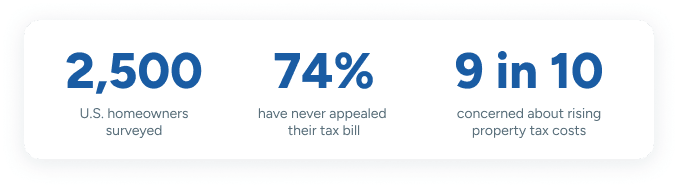
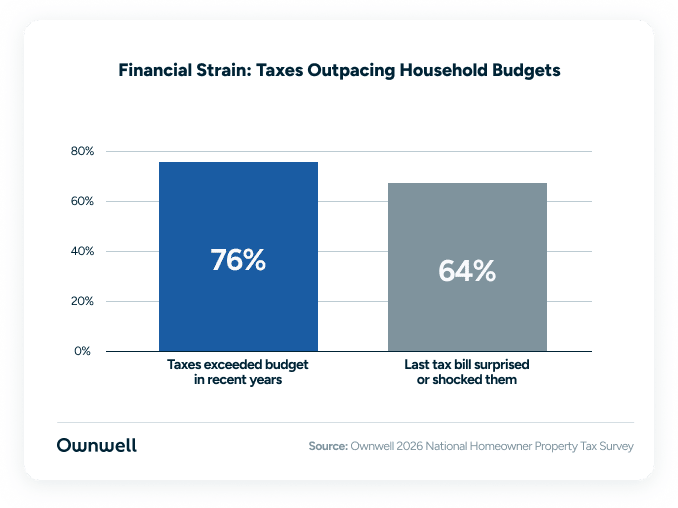
- Sixty-four percent were surprised or shocked by their most recent property tax bill, up from 59% in 2025
- 9 in 10 are concerned about the long-term financial impact of rising property taxes on homeownership
- Seventy-six percent say property taxes in recent years have been more than what they budgeted for, up 10% year-over-year
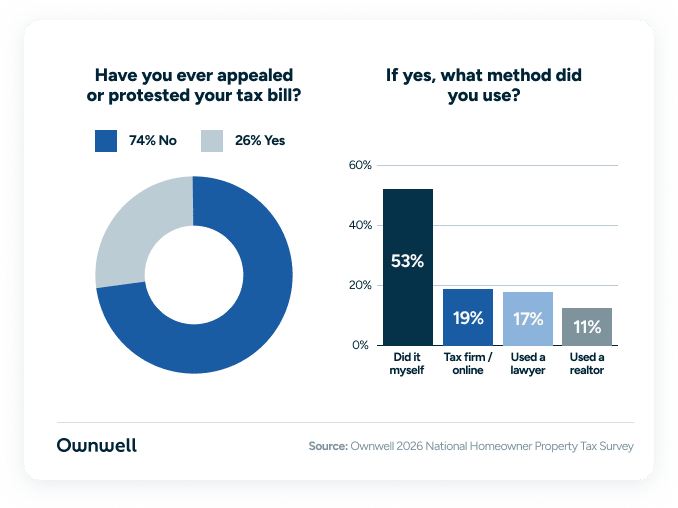
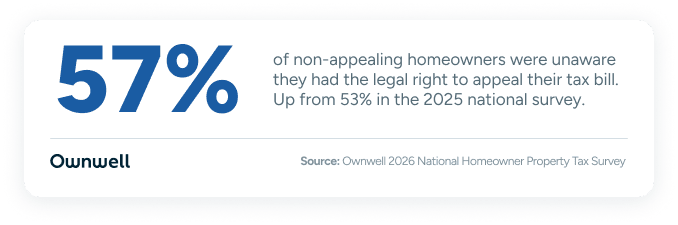
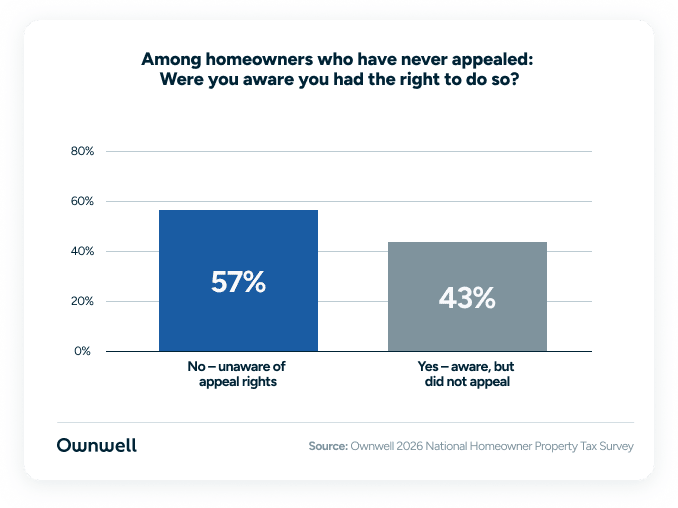
- Seventy-four percent have never appealed their tax bill (a 4% decrease from last year); of those, 57% didn’t know they had the right to
1. Property Tax Bills Are Outpacing Household Budgets
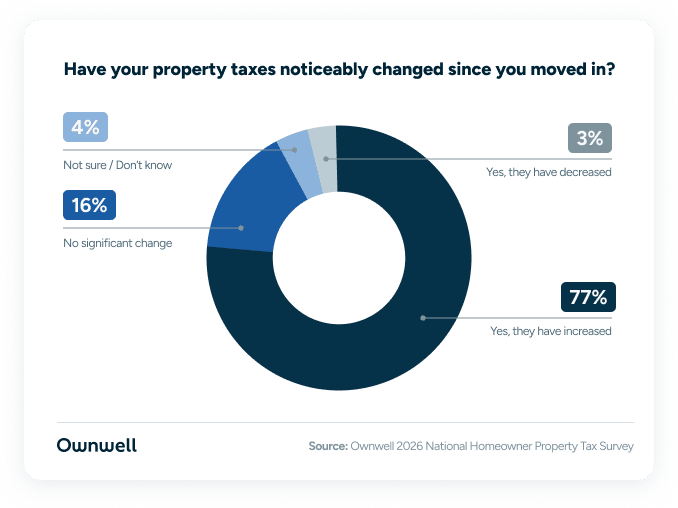
More than three in four U.S. homeowners report their property taxes have increased since moving in, and for most, those increases have been larger than anticipated.
Ownwell
The financial pressure isn’t just that taxes are rising; it’s that they’re rising faster than households can plan for. Over three in four (76%) of homeowners say their property taxes in recent years have been more than what they budgeted for, a 10-point increase from the 2025 survey.
Ownwell
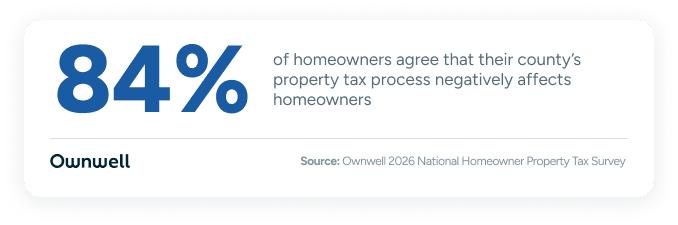
Behind that bill shock sits a deeper level of systemic frustration. Eighty-four percent of respondents agree that their county’s property tax process negatively affects homeowners — 33% strongly agree, and only 16% disagree.
Ownwell
But how does it negatively affect them?
For 22% of U.S. homeowners, their property tax bill’s total amount is too high and unaffordable, while 19% feel the valuation or appraisal process feels unfair and arbitrary.
Less than 1 in 10 are unconcerned about property taxes.
2. Most Homeowners Have Never Appealed, and Many Don’t Know They Can
Despite broad financial pressure from property tax bills, most U.S. homeowners have never used one of the formal tools available to them: the legal right to contest their property’s assessed value.
Ownwell
Seventy-four percent of homeowners have never appealed or protested their property tax bill — a slight improvement from 78% in last year’s survey.
Among the 74% who have never appealed, the knowledge gap is significant: 57% said they did not know they had the right to appeal or protest their tax bill, up four points from last year.
Ownwell
Ownwell
The other 43% knew they could appeal, yet still didn’t act. For this group, the barrier seems less about awareness and more about friction:
- Uncertainty about the process
- Limited confidence in a successful outcome
- The time and effort required
The data points to a two-part challenge.
- A persistent knowledge gap about basic taxpayer rights.
- For those who do know, it’s a confidence and access gap that prevents action.
3. The Assessment Process Feels Arbitrary and Opaque
When asked about their primary concern regarding property taxes, homeowners more often than not pointed to the fairness and transparency of the system that sets their bills.
Among those with concerns:
- Twenty-two percent say the total amount is simply too high
- Nineteen percent say the valuation and appraisal process seems unfair and arbitrary
- Seven percent cite a lack of transparency from their local government or appraiser
Only 9% of respondents said they were unconcerned about property taxes.
These concerns express not only frustration with bill amounts but also deeper distrust of how assessments are determined. The valuation process, which many homeowners feel they can’t audit or are unaware they can appeal, sits at the center of that concern.
4. Most Homeowners Are Open to Professional Help, But Privacy Represents a Barrier
For the 26% who have appealed, more than half (53%) say they handled it entirely on their own, while 19% used a tax firm or online resource, and 17% hired a lawyer.
However, given the friction around self-filing and the knowledge gaps documented above, a natural question follows:
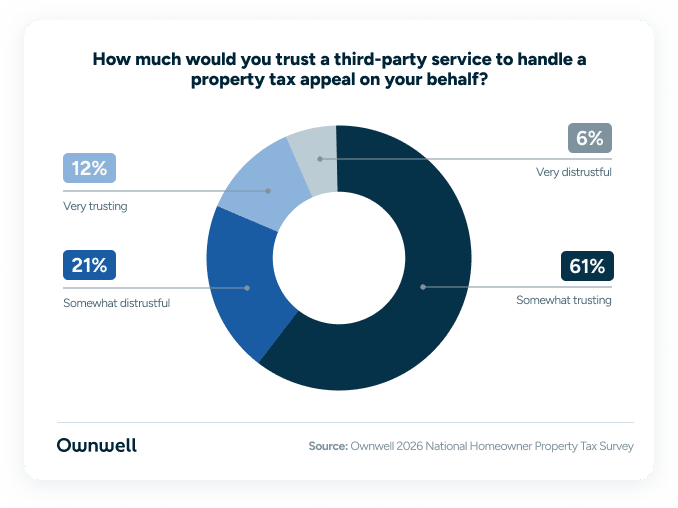
Are homeowners willing to let a third-party service handle an appeal on their behalf?
The answer, broadly, is yes.
Ownwell
Seventy-three percent of homeowners express at least some trust in a third-party service to handle an appeal on their behalf, with 12% describing themselves as “very trusting.”
However, among the 27% who are distrustful, the primary barrier is not skepticism about results; it’s autonomy and privacy.
- Forty-two percent of distrustful respondents said they simply choose to handle property matters themselves.
- Another 39% cited data privacy and security concerns.
- Only 20% doubted that a third-party service could achieve a better outcome than they could on their own.
This efficacy-versus-comfort distinction is worth noting. For most skeptics, the question isn’t whether a service can deliver results. Instead, it’s whether they’re willing to hand over control and personal information to do so.
Section 5. High Taxes Have 2 in 5 Homeowners Considering Moving
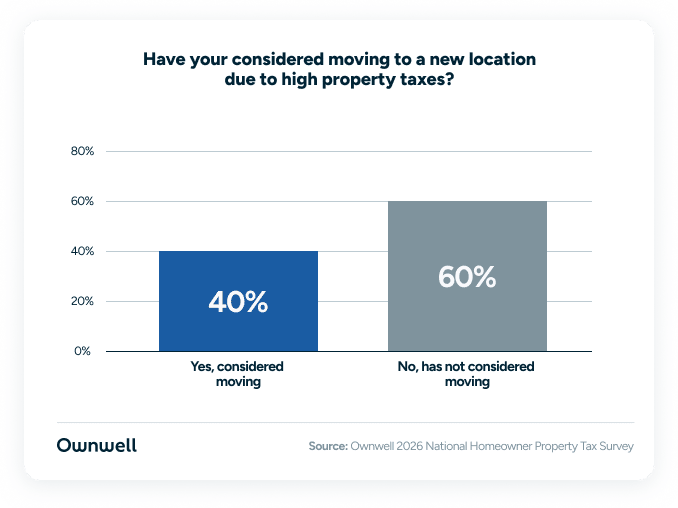
For most homeowners, their property is where they’ve planted roots. However, property taxes aren’t just an annual line item. For 2 in 5 homeowners, they’re influencing where people choose to live.
Ownwell
Forty percent of U.S. homeowners have considered moving to a new location specifically because of high property taxes. The majority (60%) have not.
But those 4 in 10 homeowners represent a notable portion for whom property taxes have become a factor in one of the most consequential decisions they can make.
Conclusion: What The Results Mean for U.S. Homeowners
Three interconnected patterns emerge from this data.
1. Monetary stress is real and worsening.
Three in four homeowners say property taxes have exceeded their budget, up 10 points from last year. That kind of year-over-year movement shows a genuine shift in how much property tax bills are burdening household finances.
2. The most direct path to relief (filing a property tax appeal) remains dramatically underused.
Nearly three in four homeowners have never done it, and more than half of those who haven’t didn’t know they could. That’s a solvable problem with education and resources.
3. Trust in appraisal systems is low.
Nearly 1 in 5 homeowners view the valuation process as opaque and difficult to challenge. In contrast, 7% of homeowners’ top concern regarding property taxes is the lack of transparency from local governments and appraisers.
Again, it’s worth noting that in most states, you can appeal or protest your appraised value annually; no legislation is required. For homeowners wanting to act, the other most direct lever is to apply for qualifying homestead exemptions.
Methodology
This study is based on a March 2026 survey of 2,500 U.S. homeowners, conducted via Pollfish. Respondents span all 50 states and the District of Columbia. Texas homeowners (n=520) were asked additional state-specific questions, which the researchers analyzed separately. You can find those results here.
Pollfish handled all data collection. Survey responses are self-reported and subject to the standard limitations of online survey research, including recall and response bias.
Ownwell conducted a comparable national survey of U.S. homeowners in 2025, enabling year-over-year comparisons where noted. The researchers rounded all percentages to the nearest whole number; in some cases, rounded figures may not sum to exactly 100%.
This story was produced by Ownwell and reviewed and distributed by Stacker.